
Telegram Infrastructure Without Weak Links: What to Check and How Telegram Expert and Pay2.House Help Cover Key Tasks
A Telegram advertising launch rarely fails because of one major issue. More often, the problem appears at the intersection of several small ones: an employee lacks the required access, a card fails verification, expenses are not assigned to a project, and no backup scenario has been prepared.
In practice, publishing a post, running an ad campaign, or handling incoming messages relies on an entire Telegram infrastructure: accounts, roles, channels and groups, bots, automation tools, payments, analytics, security, and backup scenarios.
That is why infrastructure should be checked before a problem occurs—not after it—especially before launching a new project, committing an advertising budget, or scaling operations. This article will be particularly useful for agencies, marketing teams, and owners of multiple Telegram projects.
What a Project's Telegram Infrastructure Includes
It is useful to think of a Telegram channel's infrastructure as several interconnected layers.
1. Accounts and Roles
The first priority is to understand who has access to what. The project owner, editor, moderator, advertising specialist, and technical staff do not necessarily need the same permissions.
Telegram account security should be considered separately as well: two-step verification, up-to-date linked account information, active-session monitoring, and a clear procedure for recovering from loss of access.
For a network of channels, keeping a clear account inventory is especially important. If the information exists only in one employee's head, that person's unavailability becomes an operational risk.
2. Channels, Groups, and Bots
The next layer is the platforms themselves: channels, chats, groups, bots, and the processes connected to them.
It helps to define in advance what each asset is responsible for. For example, one channel may be used for content, another for support, and a bot for processing requests. The more projects there are, the more important consistent rules for naming, role assignment, and information storage become.
3. Advertising and Payments
Promoting Telegram projects may involve both tools within the Telegram ecosystem itself and audience acquisition through external advertising platforms.
It is important to distinguish between official Telegram Ads and external paid traffic. For the latter, a team may use Meta Ads, Google Ads, TikTok Ads, and other advertising sources. In these scenarios, a separate card-payment layer becomes part of the infrastructure.
The payment method must match the specific task: currency, region, transaction type, and the service's rules. A mistake at this layer can stop a campaign even when the creatives, landing page, and analytics are already prepared.
For example, if a team uses TikTok Ads as one of its external traffic sources, the payment setup should be tested separately in advance. We covered this process in more detail in the article “How to Pay for TikTok Ads with Pay2.House Cards”.
4. Moderation and Security
Automation does not eliminate the need for control. Teams need rules for handling messages, employee restrictions, a clear access-management procedure, and a response plan for suspicious activity.
This is especially relevant for agencies and teams where several people work on the same project.
5. Analytics and Expense Tracking
If a team cannot quickly answer the questions “How much was spent?”, “On which project?”, “Which payment method was used?”, and “Who is responsible for the expense?”, the infrastructure already has a weak point.
Tracking does not have to be complicated. At the beginning, a spreadsheet or internal system is enough to record the project, advertising platform, payment method, limit, actual spend, and person responsible.
6. Backup Scenarios
A backup setup does not necessarily mean keeping dozens of spare accounts. What matters more is knowing what to do if a payment is declined, access is lost, a technical failure occurs, or a tool becomes temporarily unavailable.
A good backup scenario is documented in advance and understood by more than one person.
Where Weak Points Most Often Appear
Most problems arise not because a single service is missing, but because processes are not aligned with one another.
No access distribution. One employee controls critical accounts, while the rest of the team does not know where backup data is stored.
One payment method for everything. If the same card is used for several projects at once, it becomes harder to track spending and investigate disputed transactions.
Unprepared accounts. Launching a new advertising or operational process without preliminary checks can lead to unexpected restrictions and additional platform reviews.
No backup plan. The team knows only the primary workflow and starts looking for a solution after the problem has already occurred.
Region and currency mismatches. Payment methods, accounts, and advertising accounts should be treated as a single setup. A mismatch in region or currency can affect whether a transaction goes through.
Weak expense control. Without separate tracking, it is difficult to see which project is consuming the budget and where spending has deviated from plan.
Scaling without testing. Increasing the budget before testing payments, analytics, and workflows is a poor approach. Test a small-scale scenario first, then expand it.
A disconnect between marketing, support, and finance. The advertising specialist sees the campaign launch, finance sees the charge, and support sees the consequences. If these processes are not connected, problems are discovered too late.
Telegram Automation for Teams and Agencies
When Telegram operations involve a large number of accounts, channels, chats, and repetitive tasks, manual work quickly becomes a bottleneck.
Telegram Expert is positioned as a tool for Telegram promotion. Its official website lists features for working with accounts, finding chats and channels, creating channels and bots, publishing content, collecting audiences, sending invitations, and performing a range of other operations. Separate tools are also available for automation, reporting, and account management.
The practical value of such a tool is not to replace the entire infrastructure with one application, but to move repetitive operations into a manageable workflow.
For example, if a team regularly works with multiple channels, builds audiences, or performs repetitive actions, automation can standardize part of the process. At the same time, access rights, account-use policies, and action controls must still remain part of the internal system.
Another important point is that capabilities depend on the specific product, license, and chosen use case. Before implementation, teams should therefore verify the current feature set and documentation rather than building processes on assumptions.
The Payment Layer: External Traffic, Subscriptions, and Work Services
A Telegram project rarely exists entirely within Telegram itself. A team may acquire external traffic, use analytics services, AI tools, SaaS products, and other paid solutions.
That is why payment infrastructure deserves separate attention, especially when a team manages several advertising directions, clients, or parallel projects.
In this context, Pay2.House can be considered a virtual-card service for business payments. The service's website lists use cases for paying for advertising, subscriptions, digital products, and online services; Facebook Ads, Google Ads, and TikTok Ads are specifically mentioned among the supported advertising platforms.
The practical advantage for a team is the ability to separate payment flows. For example, a dedicated card can be used for a specific advertising direction, client, or test campaign. This simplifies accounting and makes it easier to identify where a particular expense or payment issue occurred.
With Pay2.House teams also get fast virtual-card creation, top-ups via USDT TRC20, 3DS support, and the ability to issue a large number of cards. KYC is not required for standard cards.
Different card types may be better suited to different tasks. We discussed their differences in more detail in the article “Standard vs. Personal Pay2.House Card: What's the Difference and Which One Should You Choose?”.
At the same time, virtual cards for advertising should not be treated as a universal payment solution. Whether a specific transaction is available depends on the advertising platform's requirements, the region, currency, transaction type, selected card, and the service's current rules.
That is why the correct sequence is: first determine the advertising platform's requirements, then choose a suitable payment method, and always run a test transaction.
How to Separate Payments Across Advertising Projects
Approach | Risk | What a More Systematic Setup Provides |
|---|---|---|
One card for several projects | Expenses get mixed together | A separate card or limit for each project |
Launching without a test | The problem appears only after a large budget is committed | Run a test transaction first |
No backup scenario | The campaign stops when a failure occurs | A predefined action plan |
Access held by one employee | High dependence on a single person | Role separation and backup access |
This is especially relevant for agencies. When several clients are managed at the same time, separate payment methods help keep budgets from being mixed and make reconciliation faster.
Practical Scenario: A Small Agency
Imagine a four-person team that manages three Telegram projects at the same time and buys external traffic.
Step one is to separate access rights. The owner is responsible for critical accounts, the Telegram specialist for operational tasks, the advertising specialist for ad accounts, and the finance employee for expenses. At the same time, backup data and recovery procedures should never depend on a single person.
Step two is to structure the projects themselves. For each client, the team records channels, connected bots, advertising platforms, responsible employees, and the permitted budget.
Step three is to run test payments. A separate virtual card can be prepared for an advertising direction and tested with a small budget. Pay2.House supports issuing separate cards and managing them independently, which fits this approach to organizing expenses.
Step four is to connect expenses with analytics. A spreadsheet or CRM records the project, date, advertising platform, card, amount, transaction status, and person responsible.
Step five is to document a backup scenario. If a payment is declined, an employee should not randomly change settings and repeatedly retry the transaction.
First check the balance, currency, region, platform requirements, and any available information about the reason for the decline. Only then should the team decide on the next action.
Finally, the team increases the budget only after the test succeeds. This approach does not guarantee that technical issues will never occur, but it makes them much easier to identify and investigate.
How to Connect All the Elements into One System
The easiest way to think about the infrastructure is as a chain:
accounts → access → channels and bots → automation → advertising → payments → analytics → backup scenario.
If one element drops out, the entire process is disrupted. The goal of a Telegram project owner is therefore not to accumulate as many services as possible, but to eliminate critical points of dependency.
Telegram Expert can be used where a team needs to automate and systematize repetitive operations inside Telegram. Pay2.House operates at the payment layer, where separate virtual cards and more structured tracking of business expenses are needed.
The two tools therefore solve different problems. Neither replaces the other, and a payment service does not replace account security, analytics, or access management.
What to Check First
Before launching a Telegram project, make sure that:
each employee has only the permissions they need;
accounts and channels are secured, and backup data is available to the responsible people;
the payment method has been tested with a small transaction;
expenses are separated by project and activity;
the team knows what to do if a payment is declined or access is lost.
Conclusion
Reliable Telegram infrastructure is not built around a single channel, account, or service. It is an interconnected system in which access, Telegram channel management, security, automation, advertising, payments, analytics, and failure-response procedures are planned in advance.
Before launch, it is worth checking not only the advertising campaign itself but the entire operational setup: who has access, how external advertising platforms and work services are paid for, how expenses are tracked, who monitors errors, and what happens if the primary scenario fails.
In this model, Telegram Expert and Pay2.House each have their own role: the first helps organize specific Telegram workflows, while the second helps structure part of the team's business payments through virtual cards.
The main advantage, however, comes not from any single tool but from a well-designed system in which every critical process has a clearly assigned owner, controls, and a backup option.

Download Telegram Expert - software for Telegram promotion
Telegram Expert is professional software for fast channel growth and sales in Telegram. Launch mass mailings and invites, warm up accounts without bans, consolidate dialogs in one place, and scale your team. All in one window - fast, safe, and tailored to your tasks.
What it can do:
- TDATA Converter - массово переводит session+json в TDATA.
- Booster - account warm-up via smart dialogs to increase trust.
- Registrar - account creation via any SMS services with the sms-activate standard.
- Duplicator - a second session for existing accounts for transfer and protection.
- Forwarder - routes incoming replies to a working group and sends replies to clients.
- Interceptor - catches messages by keywords from chats/channels and forwards them to you.
- Invite via admin - invitations even to restricted groups.
- Channel and chat cloner - full copies, including protected content.
- Reporter - mass complaints about messages/users/channels.
No one has left a comment yet
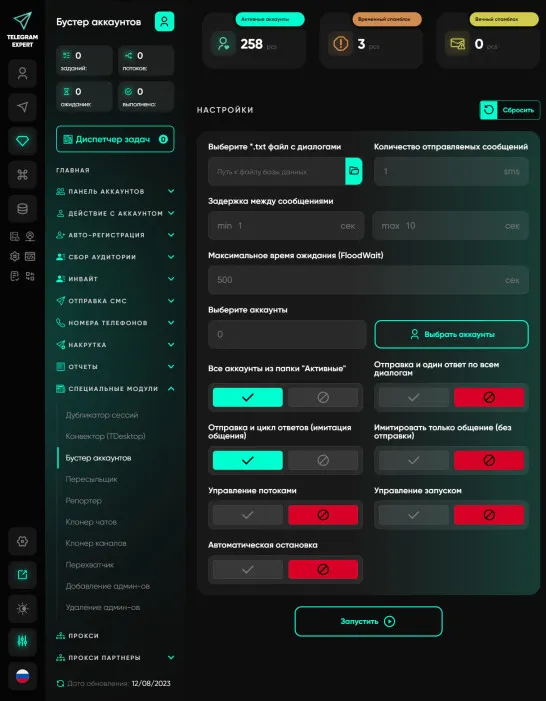
Account booster
Our unique Account Booster module, developed by the Telegram Expert team, is designed to increase trust in your accounts by simulating real communication. It has become an integral part of the strategy of many successful users. Using the Account Booster module is a process that even a beginner can master. You select a group of accounts, add a database of dialogues, and the module takes care of all the rest of the work. You no longer need to spend hours simulating activity - the module does it fo...

Managed IP Relay Infrastructure for Telegram Expert by Astro: For Registration, Messaging, and Data Scraping
In Telegram Expert scenarios, the network layer directly affects operational stability. Telegram evaluates connection characteristics from the very first minutes, including the IP address, connection origin country, connection stability, and the consistency of network behavior patterns. That’s why even a “perfect” device-level registration is ultimately constrained by the gateway infrastructure. A common mistake is trying to compensate for these limitations by adjusting module settings without c...
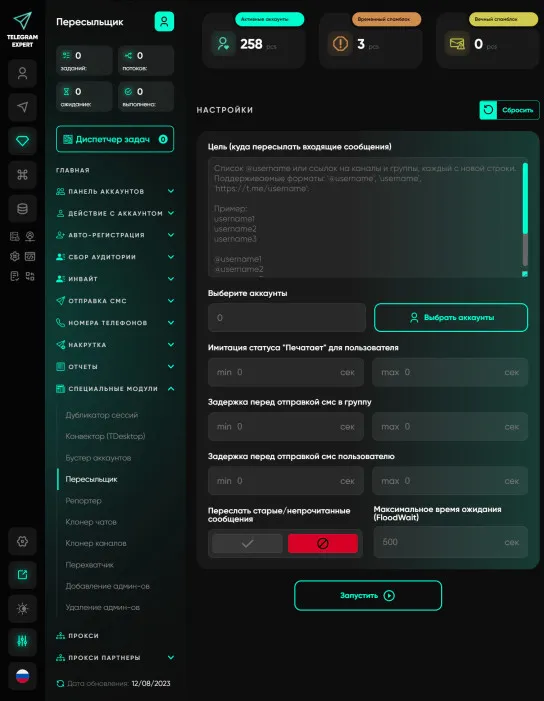
Forwarder
A unique module that works on the principle of message proxying. The principle is extremely simple, after you have sent messages from your accounts, you launch the forwarder and specify the group in which your sales managers are located. Proxy server accounts forward messages to the group, and when they see that someone from the group has responded to the message, the proxy server account forwards the response to your potential client. This allows you to communicate with a large number of people...

Complete Guide to Telegram: Channels, Groups, Bots, and Mini Apps
Telegram has long outgrown the format of «just a messenger.» It’s a place where a brand speaks in its own voice, the audience responds directly, and the entire user journey fits into a few clicks: post => chat => action. Below is a practical, lively breakdown of how to build a channel, group, bot, and mini app so that your audience stays engaged and you stay in control of growth. Channel: a voice that can be heard from any feed A channel is a promise made to your reader in the first ten seco...