
Why Telegram Accounts Die at Scale — and What It Actually Has to Do with Sessions and Network Infrastructure
Most teams figure this out only after they've already lost dozens of accounts. Not before. After.
At small volumes, Telegram behaves predictably enough. Accounts stay alive, sessions hold, distributed network nodes cycle — and the whole thing feels manageable, like a system you understand. But the moment real scaling begins — hundreds of accounts, parallel tasks, blasts and invites running simultaneously — the picture shifts. And not gradually. More like a wall. One day everything works, two days later half the pool is dead, and it's genuinely unclear what went wrong.
This isn't a bug. It's the platform's architectural behavior, and most people misread it — which is exactly why they keep working with it the wrong way.
How Telegram's Session Logic Actually Works
Telegram was built from the start as a client application with tight environmental binding. A session isn't just an auth token. It's a composite: the device, the network, the user's behavioral pattern within that network, the interaction history. When you work with one account through one phone on one carrier, all of these parameters are consistent. The platform has no reason to ask questions.
When you try to run hundreds of accounts in automated mode, the situation is fundamentally different. Each session starts living in an environment that looks unstable or contradictory from the platform's monitoring perspective. The same IP address tied to 30 active sessions. Accounts switching between distributed network gateways with different geolocations within a single day. Session files reused across different environments without updating fingerprint data.
Telegram doesn't look at each account in isolation. It looks at patterns. And if the patterns look unnatural, the system responds — just not immediately. Sometimes hours later. Sometimes days.
That delay between cause and effect is actually the core difficulty here. A team sees bans and starts looking for the problem in recent activity — yesterday's blast, a wave of invites, something from last evening. But the real problem might be in infrastructure that was set up a week ago.
What Actually Kills Accounts at Scale
The honest answer is: usually not one thing. It's a combination, and it's different for every team. But certain patterns appear often enough that they're worth naming directly.
Session reuse without environment rotation. A session file captures a snapshot of the state at the moment of authorization. When you take that session and run it in a different environment — different IP routing layer, different user-agent, different device parameters — you create a mismatch. The system receives a session whose history says one thing and whose current environment says another. Not an instant ban, but a compounding risk point.
Wrong IP rotation logic. A common mistake is running one distributed IP infrastructure across multiple accounts using round-robin or random rotation. The result: a single account has "visited" five different IP addresses from different subnets within one day. From any monitoring system's perspective, this looks like a compromised account being used by several people from different locations.
Activity without warmup. Accounts that jump into heavy operation immediately after registration — or after a long dormant period — behave in ways real users simply don't. Telegram has long learned to catch these transitions: zero activity to maximum output with no intermediate phase in between.
Datacenter network infrastructure on aged accounts. If an account was registered through a real mobile network and then starts operating through a datacenter IP, this is one of the most common session stability problems in practice. Not because datacenter routing infrastructure is inherently broken. Because it creates a discontinuity in the environment history.
Infrastructure mistake | Visible symptom | Actual cause |
|---|---|---|
One distributed IP pool shared across all accounts | Mass bans following a blast | Anomalous patterns at IP level |
Session reuse in a different environment | Re-authorization requests | Fingerprint/environment mismatch |
Registered on one IP, operating on another | Code verification and CAPTCHA prompts | History vs. current environment conflict |
Sudden activity spike without warmup | Action restrictions | Behavioral anomaly detection |
Datacenter instead of mobile traffic | Gradual account degradation | Atypical connection history |
Why Scale Itself Creates Risk
There's something counterintuitive here that most teams only understand after living through it.
With 10–20 accounts, infrastructure problems are nearly invisible. Not because they don't exist — but because even with imperfect configuration, the system doesn't accumulate enough data to establish a confident pattern. Anomalies exist, but they're isolated and statistically insignificant.
With 200–300 accounts, everything changes. The same infrastructure mistakes that previously went unnoticed now produce a stable, readable pattern across the entire pool. And the system stops reacting to individual accounts — it starts reacting to the cluster. This is why teams that scale fast without revisiting their infrastructure often don't lose a few accounts. They lose most of the pool at once.
It's not intuitive. The logic says: if a configuration worked for 20 accounts, it should work for 200. In practice, it doesn't. Scale makes hidden problems visible.
There's another point that gets less attention. As the number of accounts grows, so does the number of parallel operations. That means the response window shrinks while the cost of a mistake grows. A team that could spend a day diagnosing an issue with 20 accounts will lose the entire pool in that same day with 300.
What Mature Infrastructure Looks Like from the Inside
Teams that operate stably at high volume generally aren't using some secret tool. The difference is in taking a systematic approach to environmental consistency.
The first thing that distinguishes mature infrastructure is the "one account, one environment" principle. Each account has a dedicated IP environment that doesn't change arbitrarily. Fingerprint parameters are aligned with the session history. The environment where the account operates today doesn't look significantly different from the environment where it was created. This isn't technically hard to implement — it just requires discipline and deliberate pool organization.
The second is understanding how different network routing models map to different tasks — which matters more than it might seem upfront.
Mobile carrier-backed IP environments — especially those running through real SIM cards and carrier networks — create a fundamentally different level of environmental coherence. A session that exists in the context of a real mobile carrier looks organic. It's not about bypassing anything. It's about matching what a real Telegram user actually looks like from the platform's perspective. This is why infrastructure like Proxies.sx, operating on real 4G/5G carrier networks, has become part of serious teams' workflows — not as a circumvention tool, but as a way to build environments that behave predictably. Third is separating accounts by lifecycle stage and function. Warmup accounts shouldn't share network routing infrastructure with accounts used for blasts. Accounts with short histories shouldn't start with the most demanding tasks. This seems obvious — and it gets violated most often exactly during rapid growth, when the pressure to put new accounts to work immediately overrides the patience to warm them up properly.
Fourth is treating session health monitoring as its own function. In mature pools, sessions get checked not just for "alive or dead" status, but for signs of degradation: increasing auth error rates, rising API response latency, unusual response patterns. This lets teams catch problems before an account fully loses functionality — rather than discovering it in the middle of a campaign.
Three Scenarios That Come Up Most Often
Scenario one: fast growth that broke a working setup.
A team was running 50 accounts, the configuration was dialed in, losses were minimal. They decided to scale quickly to 300 — bought accounts, added distributed network nodes to the existing pool, launched tasks. A week later, a wave of bans began. The first instinct was to blame the accounts themselves or the supplier. The actual problem was that when new network routing servers were added to the pool, the "one account, one environment" principle broke down. Several old accounts accidentally picked up new IPs from a different subnet. That was enough.
They corrected the distribution, and things stabilized — not immediately, because by then some accounts had already accumulated an anomalous history. The lesson: growing a pool requires auditing the entire distribution logic, not just adding more resources.
Scenario two: sessions that survived registration but didn't survive the move.
A team works with purchased accounts. The supplier registers them through physical mobile devices with real carrier SIMs. The team takes the session files and runs them through datacenter IP infrastructure — cheaper, simpler to manage. The first week is fine. Then come mass verification requests and a portion of accounts entering restricted mode.
The problem isn't that the accounts are "bad." It's the gap between the environment of creation and the environment of operation. A session born in one context is trying to operate in a fundamentally different one. The system notices — and starts asking questions.
Scenario three: rotation that seemed correct.
A team followed all the community advice: using a rotating distributed IP layer, changing IPs every few hours to maintain operational continuity. Their results were worse than teams using static network environments with no rotation at all. Because the logic of "rotate IPs frequently" belonged to an earlier era. Today, unpredictable jumps between addresses are themselves a signal.
Correct rotation isn't "change as often as possible." It's "change predictably, within the behavioral range of a normal user." A real person doesn't switch carriers five times in a day.
What's Worth Understanding About Warmup Today
Warmup is one of those topics where community advice tends to lag significantly behind how things actually work. What was effective two years ago may be useless now — or actively counterproductive.
A few observations that hold up in current practice:
Formal action counts (send X messages, wait Y hours) don't create an organic profile by themselves. Pattern matters more than volume.
Warming up in an environment that doesn't match the intended working environment is warmup wasted. An account warmed up through mobile carrier-backed IP infrastructure doesn't automatically carry that "reputation" if it's later switched to a datacenter IP.
The quality of activity during warmup matters more than its duration. An account that spent two weeks reading channels and occasionally responding to messages carries more history weight than one that completed a formal checklist warmup.
Social context matters. An account that joined a few relevant groups and has some presence history there looks more organic than one created in complete isolation.
None of this means endlessly simulating a real user. It means warmup should resemble real behavior — not a ritual performed before a boost.
FAQ
Why do accounts die in waves rather than steadily?
Because the platform's monitoring system reacts to cluster-level patterns, not individual accounts. When several accounts from the same pool display similar anomalies, the system initiates a review of the entire cluster. Mass losses often don't happen at the moment of the violation — they happen later, and they hit a broad group at once.
Is warmup worth doing if accounts still get banned during blasts?
Yes, but only if warmup happens in the same environment where the accounts will operate. If the blast infrastructure differs significantly from the warmup infrastructure, almost none of the history transfers. The environment needs to be built first, and warmup happens within it.
How critical is changing IPs on an active account?
Depends entirely on how it changes. A planned IP change within the same carrier or subnet is normal mobile user behavior. An abrupt switch between datacenter and mobile traffic, or between IPs from different countries, is an anomaly. The operative question: does it look like something a real person would do?
Why are datacenter routing environments a poor fit for Telegram accounts with history?
Datacenter IPs are straightforwardly identifiable as non-user traffic. For fresh accounts that have never operated any other way, this is less critical — there's no history gap to create. For accounts registered through mobile networks, moving to datacenter IPs creates an obvious inconsistency between historical context and current environment.
How important is user-agent and fingerprint consistency in automation?
Very — and it's consistently underestimated. The session file carries device information. When the automation client transmits different device parameters, a mismatch is created. This doesn't necessarily cause an immediate ban, but it accumulates as a risk factor — especially during frequent reconnections.
How do you know a pool is degrading before mass losses occur?
Early indicators: rising floodwait rates and temporary action restrictions, increasing API response delays, more frequent re-authorization requests on accounts with solid history. If these symptoms appear across 10–15% of the pool simultaneously, that's a signal of a systemic infrastructure problem — not random attrition.
Where Telegram Infrastructure Work Is Heading
The complexity has increased — and keeps increasing. Not as a complaint about how things used to be easier. Just as an accurate description of how the market has changed.
A few years ago, basic Telegram automation meant solving a handful of relatively straightforward problems: get accounts, set up distributed IP infrastructure, write a script. Today the same tasks require a significantly deeper understanding of how session logic is constructed, how the platform interprets activity patterns, and what actually produces long-term account stability.
Teams that run stably at high volume generally don't find a "secret method." They build infrastructure where each account lives in a consistent, predictable environment. Dedicated IP environments match the account's history. Sessions don't get moved into incompatible environments. Pool growth doesn't violate the principles already in place.
That sounds simple — and in concept it is. The difficulty isn't in understanding it. It's in the discipline of not cutting corners exactly when growth is accelerating and the pressure to put everything into production immediately is highest. That's the moment most teams lose what they spent months building.
The infrastructure layer — including a properly built carrier-grade network layer running on real mobile networks — is no longer a competitive advantage. It's become a baseline requirement for stable operation. For teams starting to build this layer, it's worth noting that solutions running on real SIM cards and providing environments that look genuinely organic to monitoring systems do exist — Proxies.sx is one of them. First order discount code: WELCOME15 for 15% off.
The direction is clear enough: the advantage goes not to whoever finds the best workaround, but to whoever builds an environment that doesn't need workarounds at all.
Important: this website is the only official website of the Telegram Expert project. Licenses, updates, and official technical support are available only through this website. Any other websites offering Telegram Expert are not affiliated with BLB.Team and are either unofficial or fraudulent.
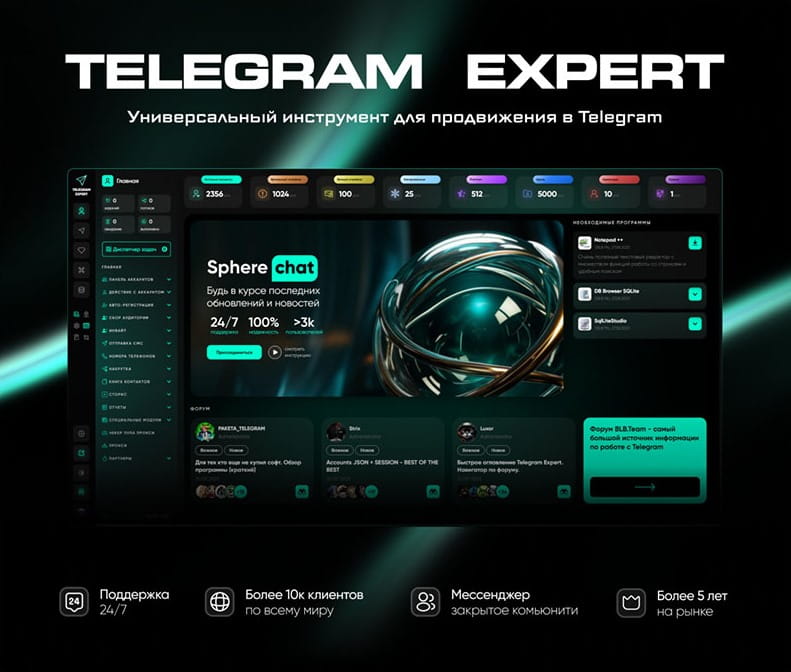
Download Telegram Expert - software for Telegram promotion
Telegram Expert is professional software for fast channel growth and sales in Telegram. Launch mass mailings and invites, warm up accounts without bans, consolidate dialogs in one place, and scale your team. All in one window - fast, safe, and tailored to your tasks.
What it can do:
- TDATA Converter - массово переводит session+json в TDATA.
- Booster - account warm-up via smart dialogs to increase trust.
- Registrar - account creation via any SMS services with the sms-activate standard.
- Duplicator - a second session for existing accounts for transfer and protection.
- Forwarder - routes incoming replies to a working group and sends replies to clients.
- Interceptor - catches messages by keywords from chats/channels and forwards them to you.
- Invite via admin - invitations even to restricted groups.
- Channel and chat cloner - full copies, including protected content.
- Reporter - mass complaints about messages/users/channels.
No one has left a comment yet
How We Run 50+ TikTok and Instagram Accounts: A Practical Setup Guide with Antidetect Browsers and Mobile Network Tools
If you are trying to drive traffic to a Telegram channel, a CPA offer, or an online store in 2026, short-form video is still the most reliable free organic channel available. Posting three clips a day on a single personal account rarely brings consistent volume. But when you manage 50 accounts posting three clips daily, you publish 150 videos every single day. Even if 40 of those videos get only 600 views, a handful will catch the algorithm and hit 50,000 to 200,000 views, sending h...

How to Choose and Set Up IP Connections for Data Collection and Global Workflows
A practical guide to selecting gateway types, configuring connections, and testing them before scaling a project. Introduction Collecting online data across markets can be more complicated than sending requests to a website. Search results, product prices, available content, and advertising displays may vary by region. At the same time, automated workflows need a connection setup that is appropriate for their workload, location requirements, and budget. A gateway...

Telegram Expert New Year Promo: 25% Off Until January 11 + Bonuses
[media mw=100]3156[/media] Dear friends and colleagues, the BLB.Team congratulates you on the upcoming New Year of the Fire Horse! 🐎 We hope that 2025 has been successful for you, and that 2026 will bring even more profit and achievements. We are truly grateful that you are with us. This really matters. A big year lies ahead, and we will do everything to ensure that Telegram Expert remains your main and most reliable tool for any tasks in Telegram. And we are already starting — our so...
Audience gathering
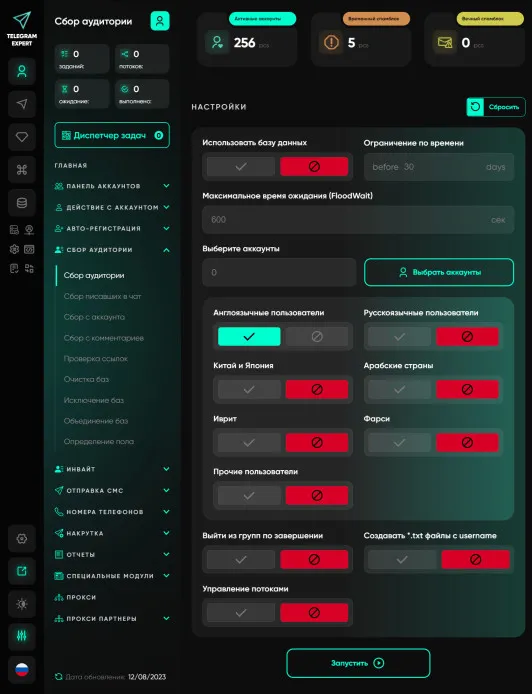
An audience is an essential component of any business. No matter what you sell, you need customers, you need an audience. Telegram Expert has truly enormous functionality; it has everything you need - collecting chat participants, collecting chat writers, collecting users from comments, etc. And all these modules are included in the base module. But this is not the main advantage; with Telegram Expert you will be able to work more efficiently, this is achieved through the introduction of advance...