
From Search to Telegram: Building a Smarter Geo-Targeted Lead Generation Strategy in 2026
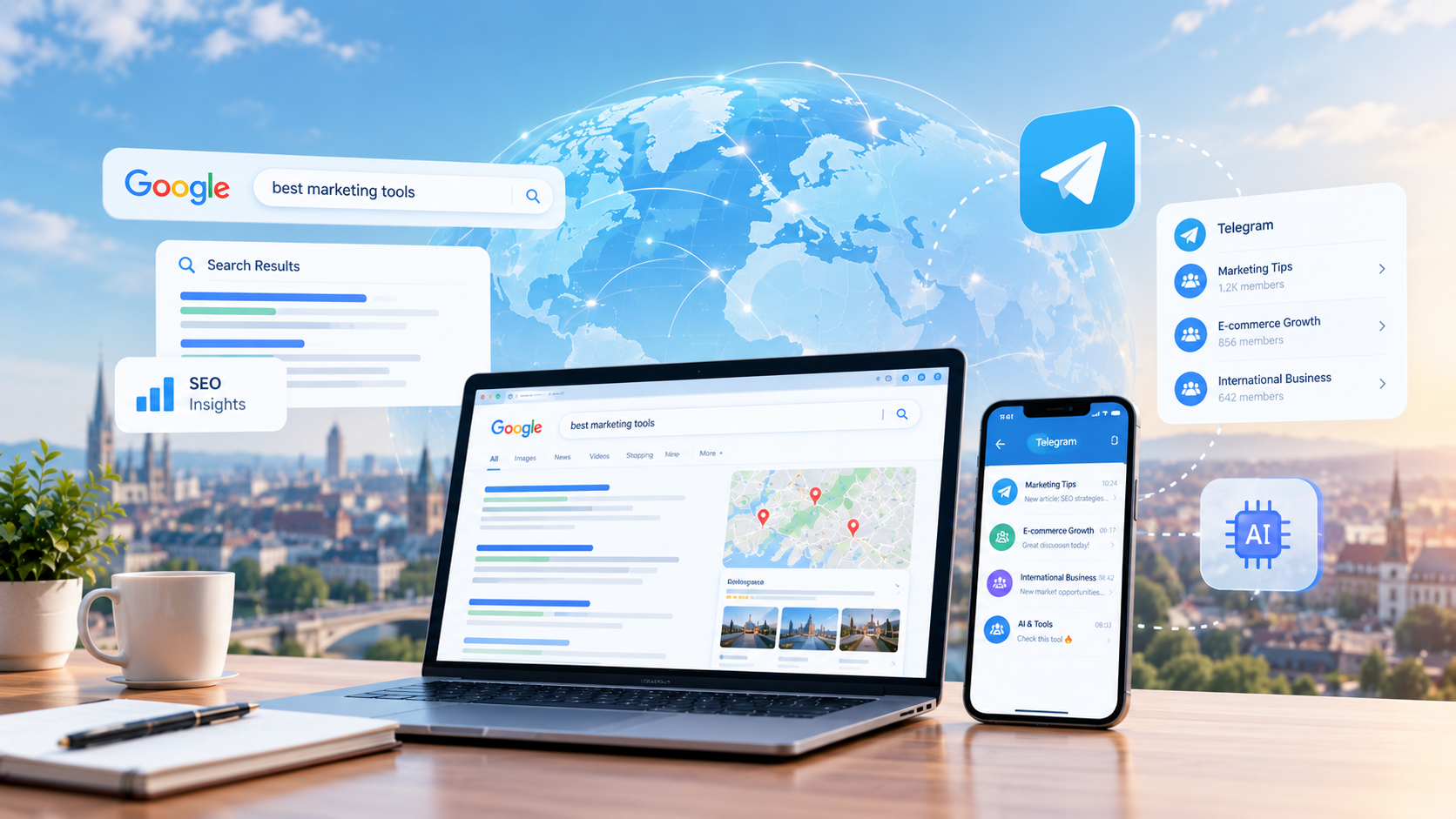
Modern lead generation is no longer simply about driving as much traffic as possible to a landing page. For businesses operating across multiple countries, the bigger challenge is understanding what potential customers actually see, search for, and respond to in each market.
Search results, advertising messages, pricing, recommendations, and online communities can all vary by location. As a result, marketers need to look beyond global averages and understand the local digital environment before deciding where to invest their time and budget.
This is where geo-targeted research becomes valuable. By combining localized search intelligence, market research, and audience discovery, marketers can build a more reliable path from initial search intent to meaningful conversations on channels such as Telegram.
Why Location Matters More Than Most Marketers Think
A common mistake in international marketing is assuming that a search performed in one country will produce essentially the same experience everywhere.
In reality, location can influence search rankings, advertisements, product offers, local competitors, pricing information, and the content users are most likely to encounter.
For example, a marketer researching a commercial keyword from the United States may see a completely different set of results from a customer searching for the same term in Germany. Even when the keyword remains unchanged, the commercial intent behind the results may be different.
That creates a fundamental research question:
What does our target customer actually see?
For international SEO and market research, this question is often more useful than simply asking which pages rank globally.
A localized research workflow allows marketers to examine search results, advertisements, landing pages, and offers from the perspective of specific markets. Residential IP gateway networks can be particularly useful for this type of research because they allow teams to work with geographically relevant IP environments rather than relying entirely on a single location.
For marketers conducting this type of research at scale, IPFLY’s residential network gateways can be used as part of a broader workflow for localized search analysis, market research, and regional data collection.
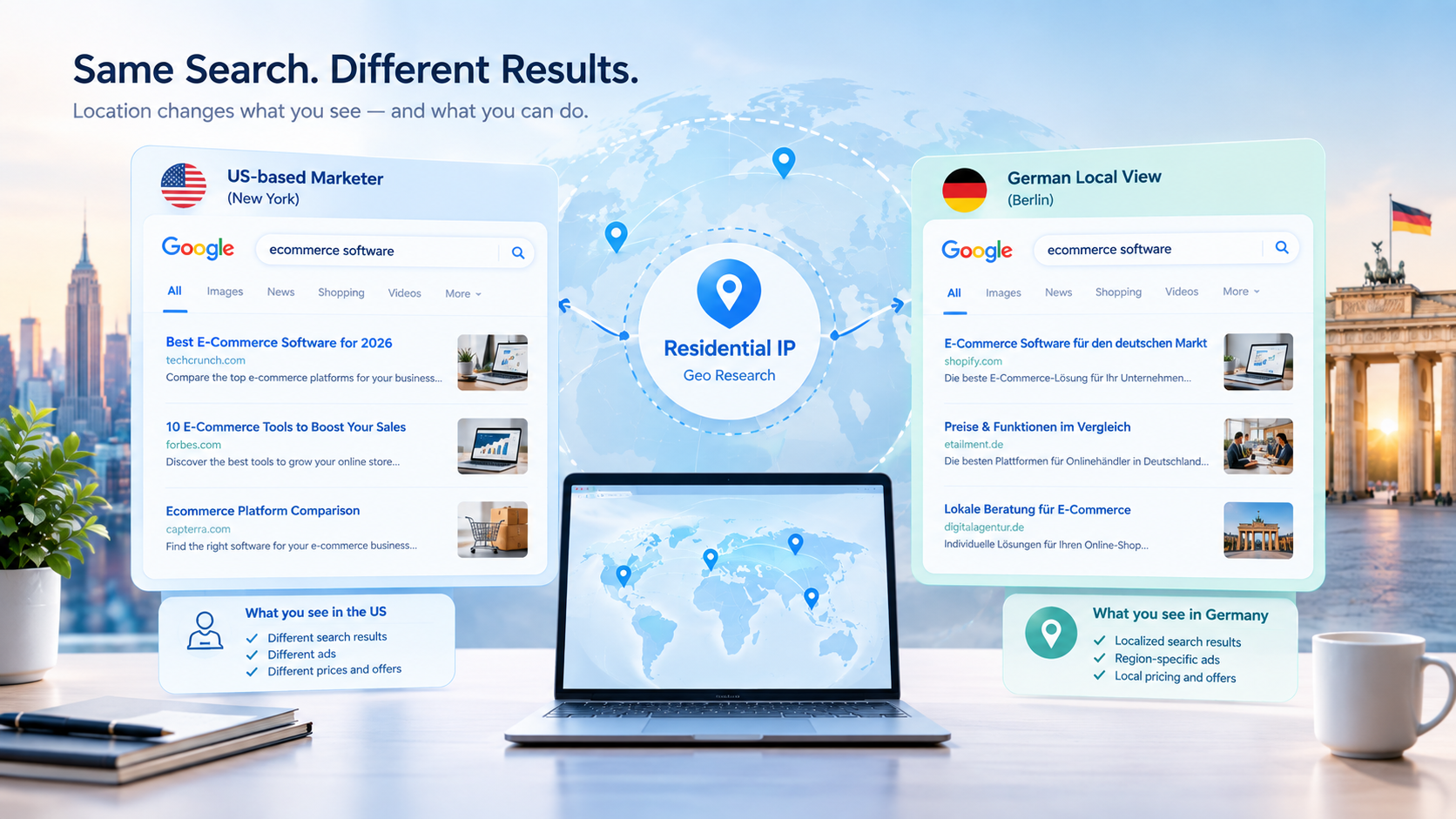
The purpose is not to imitate a local user for its own sake. The real objective is to understand how the digital experience changes between markets and use those observations to make better marketing decisions.
From Search Intent to Telegram Audience
Once marketers understand how a market behaves in search, the next step is identifying the audiences behind that demand.
Search queries reveal what people are actively looking for. Telegram communities can reveal where people discuss those interests, exchange recommendations, ask questions, and interact with others who share similar needs.
This creates an opportunity to connect two different types of signals:
Search data shows what people are looking for.
Community data shows where relevant audiences gather.
Engagement data shows which topics generate real interest.
Conversion data shows which audiences are commercially valuable.
The key is to avoid treating an entire country or city as one audience.
A better approach is to build audience segments around specific interests, problems, industries, and search intent. A business targeting the German market, for example, may discover that its strongest opportunities are not simply “German users,” but several smaller groups with different needs and levels of purchase intent.
Geographic keyword research can help identify these differences before marketers begin large-scale outreach. Instead of relying on one global keyword list, teams can analyze search behavior by country, region, or city and use those insights to prioritize markets.
For businesses working on international SEO, IPFLY’s SEO optimization capabilities can support geographic keyword research and location-specific ranking analysis as part of this process.
The result is a more focused audience strategy: first understand the market, then identify the communities that reflect that demand.
Build Audiences Around Interests, Not Just Locations
Geographic targeting tells you where an audience is. It does not necessarily tell you why they are interested.
That distinction becomes especially important on Telegram.
Telegram contains communities built around industries, hobbies, professional interests, local markets, products, and highly specific topics. A broad location-based strategy may therefore miss the smaller communities where the most relevant prospects actually spend their time.
Audience research should begin with the topic rather than the contact list.
For example, instead of searching only for users located in a particular country, marketers can identify channels and groups related to:
A specific product category
A recurring customer problem
A professional niche
A local industry
A particular type of buyer
A market-specific trend
Once relevant communities have been identified, audience parsing and segmentation can help organize the research process. Tools such as Telegram Expert’s audience parsing tools can help collect relevant audience signals, identify active participants, validate data, and organize prospects into more useful segments.
The important principle is relevance.
A smaller audience with a strong connection to the topic is often more valuable than a large database assembled only around geography.
AI Should Make Communication More Relevant
Once the right audience has been identified, the next challenge is communication.
This is where AI can provide practical value, but it should not replace human judgment.
One of the biggest problems with automated outreach is repetition. The same message sent to every user can quickly become irrelevant, particularly when audiences come from different markets and have different expectations.
A better approach is to use AI to assist with personalization.
For example, AI can help marketers:
Adapt messages to different audience segments
Summarize recurring questions from communities
Generate multiple content variations
Adjust tone for different markets
Identify common objections
Turn research findings into content ideas
The underlying principle is simple: automation should increase relevance, not simply increase volume.
If research shows that a particular market responds to educational content, the communication strategy should reflect that. If another audience is more interested in pricing, case studies, or product-specific information, the messaging should change accordingly.
This is also where human review remains important. AI can generate and organize information quickly, but marketers still need to decide whether a message is genuinely useful to the audience.
Connect SEO, Advertising, and Telegram Data
The strongest geo-targeted strategies do not treat SEO, advertising, and Telegram as separate marketing activities.
They use each channel to improve the others.
For example, localized SEO research may reveal that users in one market are searching for a specific problem. Advertising research can then show how competitors are positioning their solutions. Telegram communities may reveal the language users actually use when discussing that problem.
Together, these signals provide a much clearer picture of market demand.
This approach can be extended to advertising verification and competitive research. Instead of asking only whether an advertisement is running, marketers can examine how offers, messaging, and positioning vary between locations.
Similarly, market research can reveal broader patterns in consumer demand and competitor activity. IPFLY’s market research solutions can fit into this workflow by helping marketers investigate market-specific trends and competitive signals.
The result is a feedback loop:
Search reveals demand.
Market research adds context.
Telegram reveals conversations.
Engagement reveals interest.
Conversion data reveals value.
Rather than optimizing each channel independently, marketers can use these signals to make better decisions across the entire acquisition process.
Once these signals have been validated, Telegram Soft Expert can serve as the Telegram automation software layer for the Telegram side of the funnel. Teams can organize multiple accounts, work with parsed audience segments, run targeted broadcasts, and keep recurring Telegram workflows in one place. This makes it easier to move from geo-targeted research to execution without turning market analysis into manual account-by-account work.
A Practical 30-Day Test
This strategy does not require a large team or a complicated technology stack.
A focused 30-day experiment can provide enough information to determine whether a particular market and audience deserve further investment.
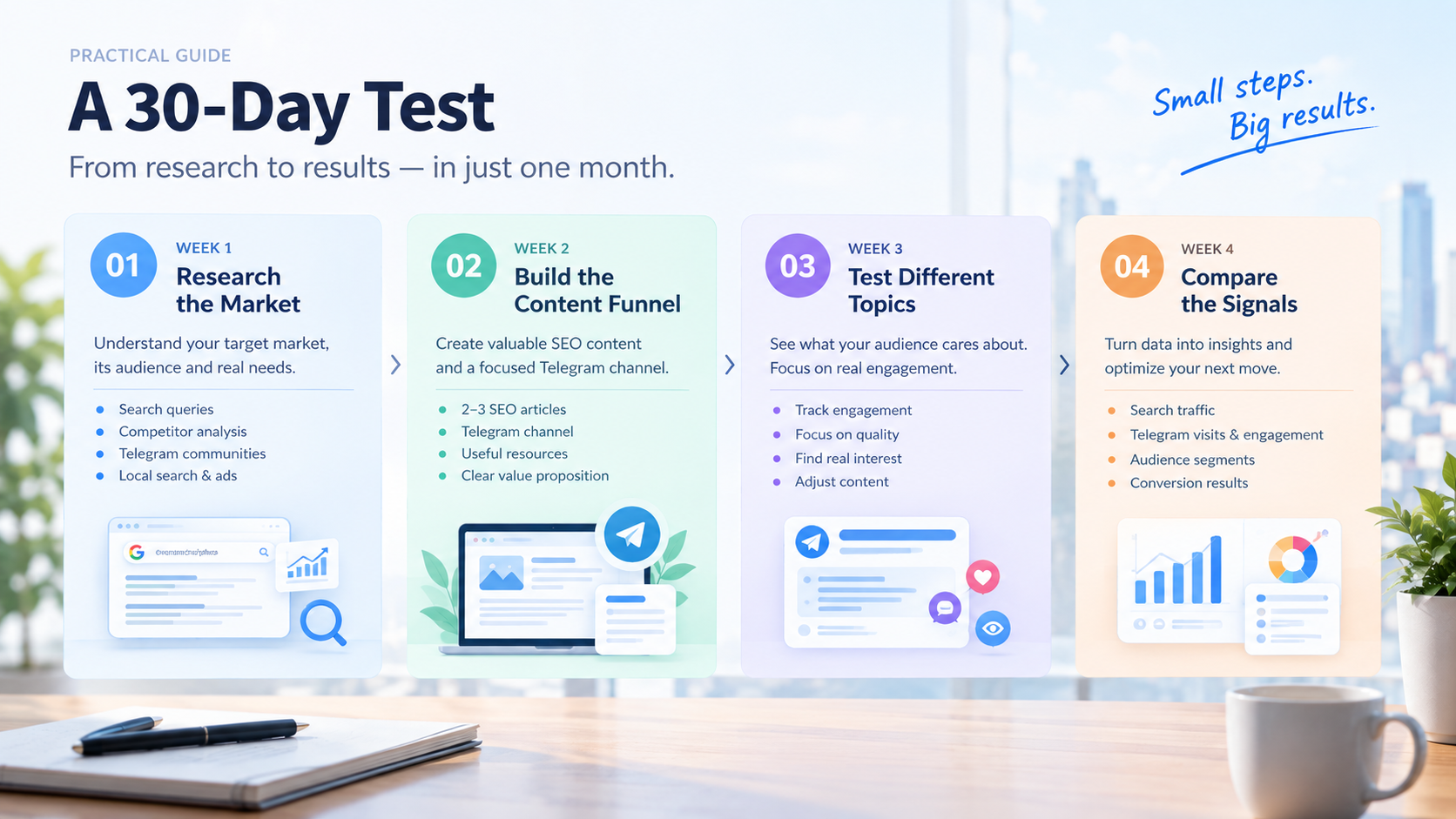
Week 1: Research the Market
Start with a small number of target markets.
Research:
Local search queries
Competitor positioning
Relevant Telegram communities
Local advertising patterns
Common audience problems
The objective is not to collect as much data as possible. It is to identify a few meaningful patterns.
Week 2: Build the Content Funnel
Turn those findings into useful content.
Create a small set of SEO-focused articles, guides, resources, or landing pages around the strongest topics. At the same time, identify relevant Telegram communities and define the audience segments worth testing.
The connection between search content and Telegram should be intentional. A person discovering your brand through search should find the same value proposition when they encounter your Telegram presence.
Week 3: Test Different Topics
Do not test everything at once.
Choose a few content themes and audience segments. Track which topics generate meaningful engagement rather than focusing only on raw traffic or message volume.
Useful signals can include:
Search traffic
Click-through rates
Telegram engagement
Replies
Community interactions
Qualified leads
The goal is to discover what actually resonates.
Week 4: Compare the Signals
At the end of the month, compare the results across markets and audience segments.
Ask:
Which market showed the strongest demand?
Which search topics generated the most qualified interest?
Which Telegram communities were most relevant?
Which messages generated meaningful responses?
Which activities contributed to actual conversions?
This final step turns scattered data into a repeatable decision-making process.
What Should Actually Be Automated?
Automation is useful when it removes repetitive work. It becomes counterproductive when it replaces strategic thinking.
Tasks such as account organization, scheduled publishing, database management, routine audience segmentation, and repetitive communication workflows can often be systematized.
This is where a dedicated Telegram workflow can help. Telegram Expert provides tools for account management, audience organization, publishing, messaging, and other repetitive Telegram operations.
However, the strategic decisions should remain human-led.
Marketers should decide:
Which markets to prioritize
Which audiences are relevant
What value to offer
Which messages are appropriate
When an interaction requires a human response
The most effective model is therefore not “full automation.”
It is research first, automation second.
Turning Telegram Into a Source of Market Intelligence
Telegram should not be viewed only as a distribution channel.
Its communities can also provide valuable qualitative market intelligence.
Repeated questions, discussions, objections, recommendations, and emerging topics can reveal information that may not appear clearly in conventional keyword research.
For example, search data might show that users are interested in a particular product category. Telegram discussions may reveal the specific concerns behind that interest: pricing, reliability, integration, customer support, regional availability, or another issue.
These insights can then feed back into SEO content, advertising messages, landing pages, and product positioning.
That creates a more complete research cycle:
Discover the market → understand local demand → find relevant communities → test messaging → measure engagement → refine the strategy.
The advantage is not simply more data.
It is better context.
Conclusion
The future of international lead generation is unlikely to be built around a single channel.
Search can reveal demand. Geographic research can reveal how that demand changes between markets. Market intelligence can explain competitive conditions. Telegram can provide access to highly specific communities. AI and automation can then make the process more efficient.
The key is connecting these pieces in the right order.
Start with the market rather than the channel. Understand what people actually see in their local digital environment. Identify the problems and topics that matter to them. Find the communities where those conversations already exist. Then use automation to scale what has already been validated.
For businesses looking to build a more precise international acquisition strategy in 2026, the opportunity is not simply to reach more people.
It is to understand the right market, the right audience, and the right context before reaching out.
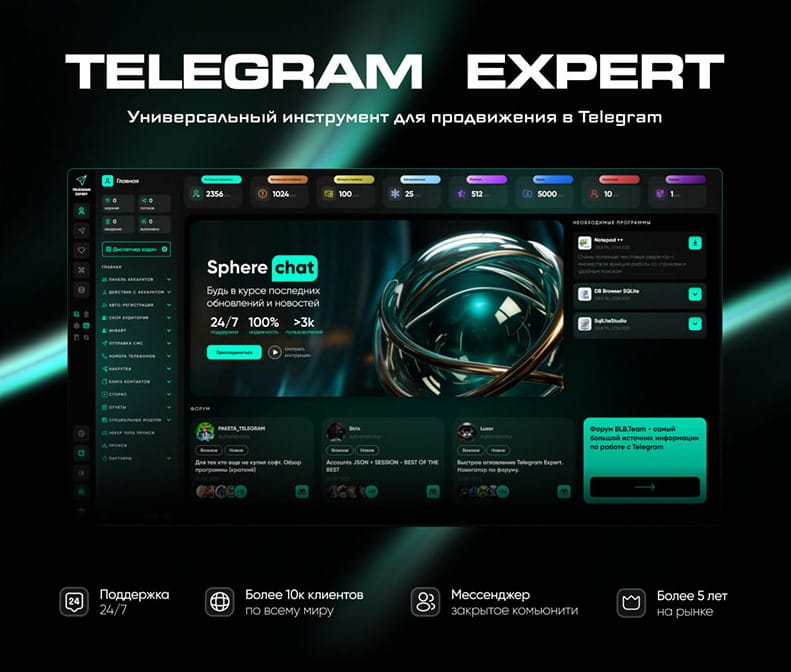
Download Telegram Expert - software for Telegram promotion
Telegram Expert is professional software for fast channel growth and sales in Telegram. Launch mass mailings and invites, warm up accounts without bans, consolidate dialogs in one place, and scale your team. All in one window - fast, safe, and tailored to your tasks.
What it can do:
- TDATA Converter - массово переводит session+json в TDATA.
- Booster - account warm-up via smart dialogs to increase trust.
- Registrar - account creation via any SMS services with the sms-activate standard.
- Duplicator - a second session for existing accounts for transfer and protection.
- Forwarder - routes incoming replies to a working group and sends replies to clients.
- Interceptor - catches messages by keywords from chats/channels and forwards them to you.
- Invite via admin - invitations even to restricted groups.
- Channel and chat cloner - full copies, including protected content.
- Reporter - mass complaints about messages/users/channels.
No one has left a comment yet
Telegram Marketing: How to Avoid Bans with the Right Gateway Setup
Scaling Telegram automation is often treated as a behavioral problem. Most operators focus on delays between actions, account warm-up, and message limits. Even when these elements are well optimized, issues such as random bans, session instability, and inconsistent performance still appear. At scale, this assumption breaks. The problem is not behavior. It is the network layer behind each connection. If you’ve worked with Telegram automation, you’ve likely seen this pattern: everything is “opt...

Automating Multi-Accounting in ChatGPT and Midjourney for Agencies
For an agency generating text, visuals, and content daily for dozens of clients, a single ChatGPT or Midjourney account quickly becomes the main bottleneck. Request limits, image-generation queues, and plan-tier restrictions can bring any volume-driven production process to a halt. The obvious answer is working with several accounts in parallel — different projects, different teams, different loads. But as soon as multiple accounts enter the picture, a new layer of complexity appears: how to ...

How to Safely Manage Multiple Telegram Accounts and Avoid Constant Security Checks
Why Telegram Pays Attention to Suspicious Activity Telegram remains one of the most popular platforms for communication, marketing, customer support, and workflow automation. Many users operate multiple accounts to separate personal communication, business activities, marketing campaigns, or different projects. However, when managing several accounts, some users encounter repeated login requests, additional verification steps, or other security checks. In most cases, this is not ca...
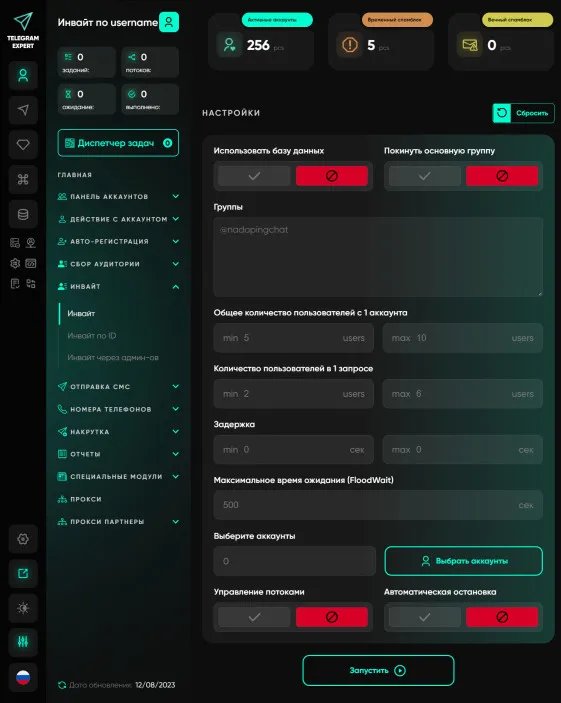
Invite
Invite is an invitation to a group or channel. Creating a large group in Telegram is not an easy task. You need to monitor advertising and content; very often this is a rather long method to get the right audience; an invite is easier and cheaper. The “Invite” module will allow you to invite people to your group by username, id and phone number. The module has excellent functionality, good and understandable statistics. You can invite your audience to several groups at the same time. As a rule, ...