
How AI Agents Use Network Intermediaries for Reliable Web Data Collection in 2026 | Gateproxies
AI DATA INFRASTRUCTURE GUIDE
AI agents can search, compare, monitor, and summarize public web information faster than a manual research team. Their output is only as reliable as the data pipeline beneath them. IP routing infrastructure matters when that pipeline needs geographic coverage, repeatable sessions, parallel collection, and clean separation between requests.
2026 trend guide
Practical infrastructure
7 original visuals

A modern AI collection system combines agent logic, routing through intermediary servers, validation, and traceable data storage.
Public web data now feeds product intelligence, price monitoring, search analysis, travel research, inventory tracking, and retrieval-augmented generation systems. In October 2026, industry coverage reported that AI platforms themselves had entered lists of heavily monitored websites, reflecting a shift from tracking what people search for to tracking what AI systems tell them. The reported change is a useful signal: organizations increasingly need current, repeatable web observations instead of occasional snapshots.
At the same time, AI does not remove the difficult parts of data collection. Websites vary by country, currency, device, language, session, and time. Pages can return incomplete content, redirect unexpectedly, or change structure. An agent may reason correctly while working from stale or geographically incorrect input.
This is where network intermediaries fit. An intermediary does not make collected data accurate by itself. It gives the collection system control over the network route. Reliability still depends on source selection, session design, validation, retries, and compliance.
Scope: this guide covers authorized collection of public web information. It does not recommend bypassing access controls, ignoring site terms, collecting private data, or using infrastructure to conceal abusive activity.
1 Why AI agents need live web data
A language model can explain existing knowledge. A connected agent can observe what is happening now.
An AI agent becomes more useful when it can retrieve fresh information before answering or acting. A retail team may ask it to compare current prices across countries. A travel business may monitor room availability. An SEO team may collect regional search results. A procurement team may watch stock changes across supplier catalogs.
These tasks share four requirements:
Freshness: the observation must represent the current page, not an old training snapshot.
Location: the result must come from the market being measured.
Repeatability: the same collection rule should produce comparable records over time.
Traceability: every result should preserve its source, collection time, and validation status.
The 2026 State of Web Scraping report includes AI scraping and infrastructure among the themes shaping web collection. The practical implication is that more teams are moving from one-off scripts to managed pipelines where agents plan tasks and infrastructure controls how those tasks reach public sources.
2 Where IP routing infrastructure fits
A network intermediary is the routing layer between an agent's plan and the public source being observed.
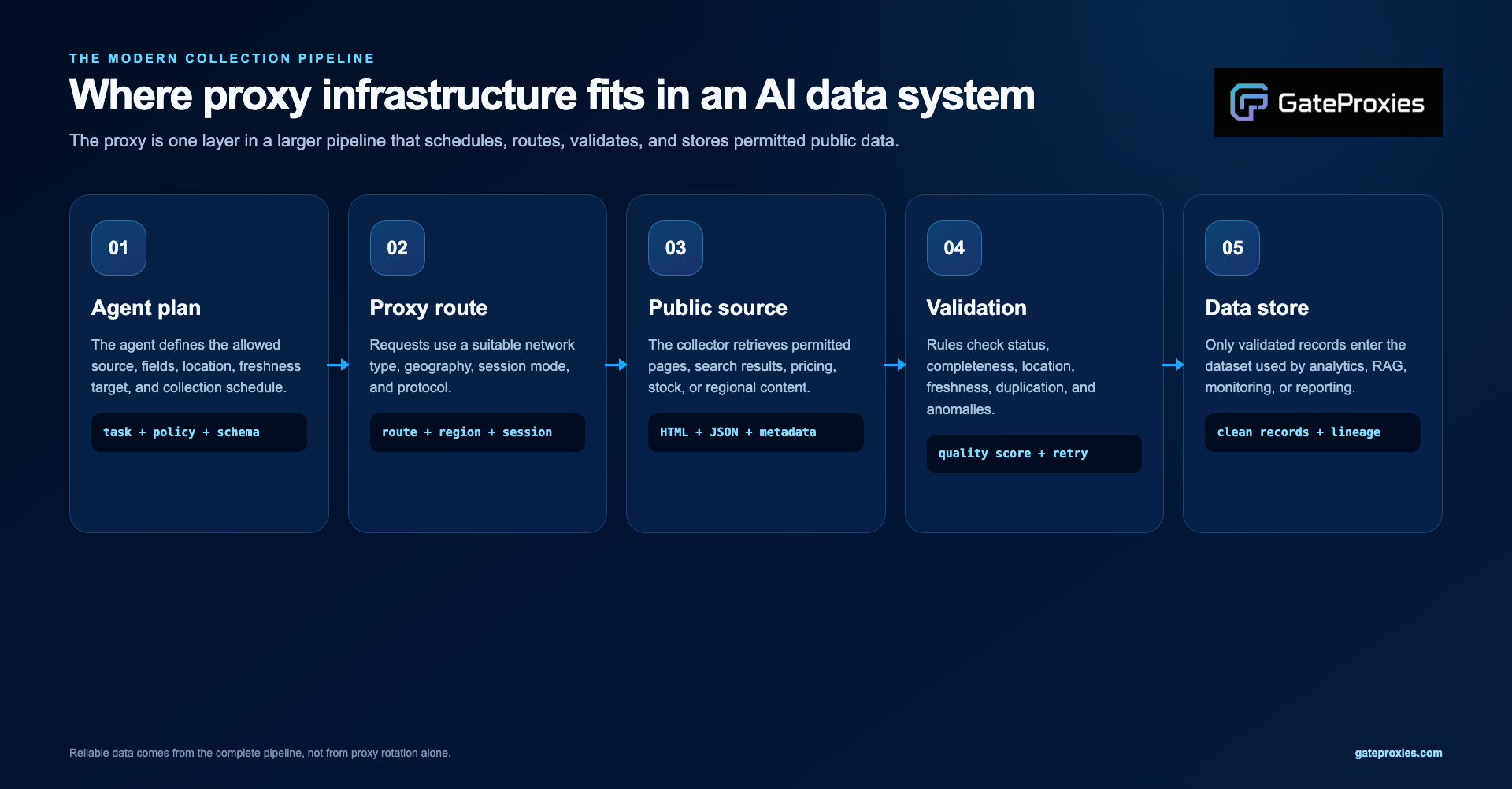
A dependable pipeline plans the task, selects a route, retrieves permitted data, validates the response, and stores only usable records.
A well-structured system begins with a task definition. The agent should know the allowed source, required fields, location, freshness window, and stopping condition. The routing layer then chooses the network node type, region, protocol, and session behavior. After retrieval, validation rules check whether the result is complete and actually represents the expected market.
Only validated records should enter the dataset. Failed pages, location mismatches, empty prices, duplicate records, unexpected login screens, and unusual redirects should be flagged instead of being silently summarized by the agent.
This separation matters during troubleshooting. If a task fails, the team can identify whether the cause came from agent planning, the network route, the target page, the parser, or the validation rules. Without that separation, every failure looks like “the scraper is broken.”
If validated web data feeds Telegram research, monitoring, or outreach workflows, Telegram Expert can serve as the Telegram operations layer above the collection pipeline. Teams can manage multiple Telegram accounts, search chats and channels, collect relevant audiences, run different types of broadcasts, and use auto-replies, while Gateproxies remains responsible for the network route used by the external data-collection layer.
3 Use an API when an appropriate API exists
Collection through network nodes should not be the automatic first choice for every source.
If a website offers an official API with the required fields, acceptable freshness, and workable commercial terms, that API is often the cleanest source. It provides a documented contract and reduces parsing work. A network intermediary becomes relevant when the permitted information is available only through public pages, when regional page rendering is part of the measurement, or when an API omits the market-specific result being studied.
Before building a collector, document why the web page is required. This prevents an expensive browser pipeline from replacing a simpler integration and creates a clear compliance record for the project.
4 Choose the network node type by workload
Residential, mobile, ISP, IPv4, and IPv6 routes have different operating profiles.
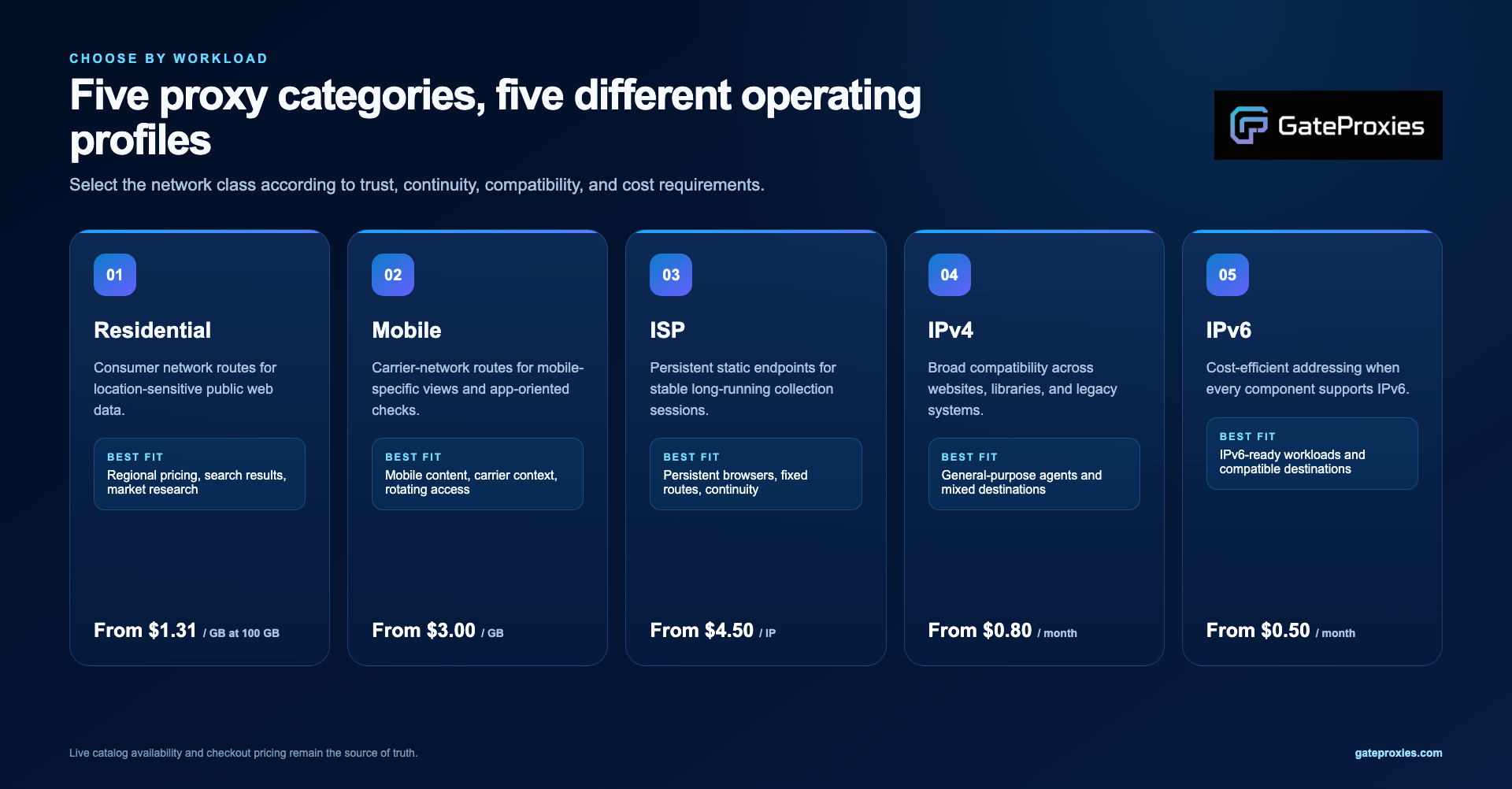
There is no universal best network node. The useful choice is the one that matches the destination, session model, geographic need, and budget.
Residential network nodes for location-sensitive data
Residential network nodes use addresses associated with consumer internet networks. They are useful for public pages that vary by country, region, or city. Typical research tasks include regional pricing, localized search results, travel availability, marketplace listings, and market-specific catalogs.
They are usually billed by traffic, so HTML-only collection may be economical while image-heavy rendered browsing can consume data quickly. The collection plan should block unnecessary media where permitted and measure bandwidth per successful record.
Mobile network nodes for carrier-specific views
Mobile network nodes use carrier network routes. They fit tasks where a mobile network context is part of the observation, such as mobile-specific content, app-facing checks, or carrier-oriented regional experiences. Mobile traffic generally costs more than residential traffic, so it should be chosen because the workload needs it, not because it sounds more trusted.
ISP network nodes for persistent sessions
ISP network nodes provide stable endpoints that can remain consistent across long-running jobs. They work well for rendered browser agents, persistent sessions, and repeat collection where changing the network identity would disrupt the workflow. Pricing per IP can also make long sessions easier to budget.
IPv4 and IPv6 for compatibility and scale
IPv4 offers the broadest destination and software compatibility. IPv6 can provide cost-efficient addressing, but every component must support it, including the destination, operating system, client library, container network, and network connector. A collector that silently falls back to the direct IPv4 connection creates both accuracy and privacy problems.
The public Gateproxies residential network page presents the available network capabilities and protocols. Actual location inventory and package terms should always be confirmed in the live account catalog.
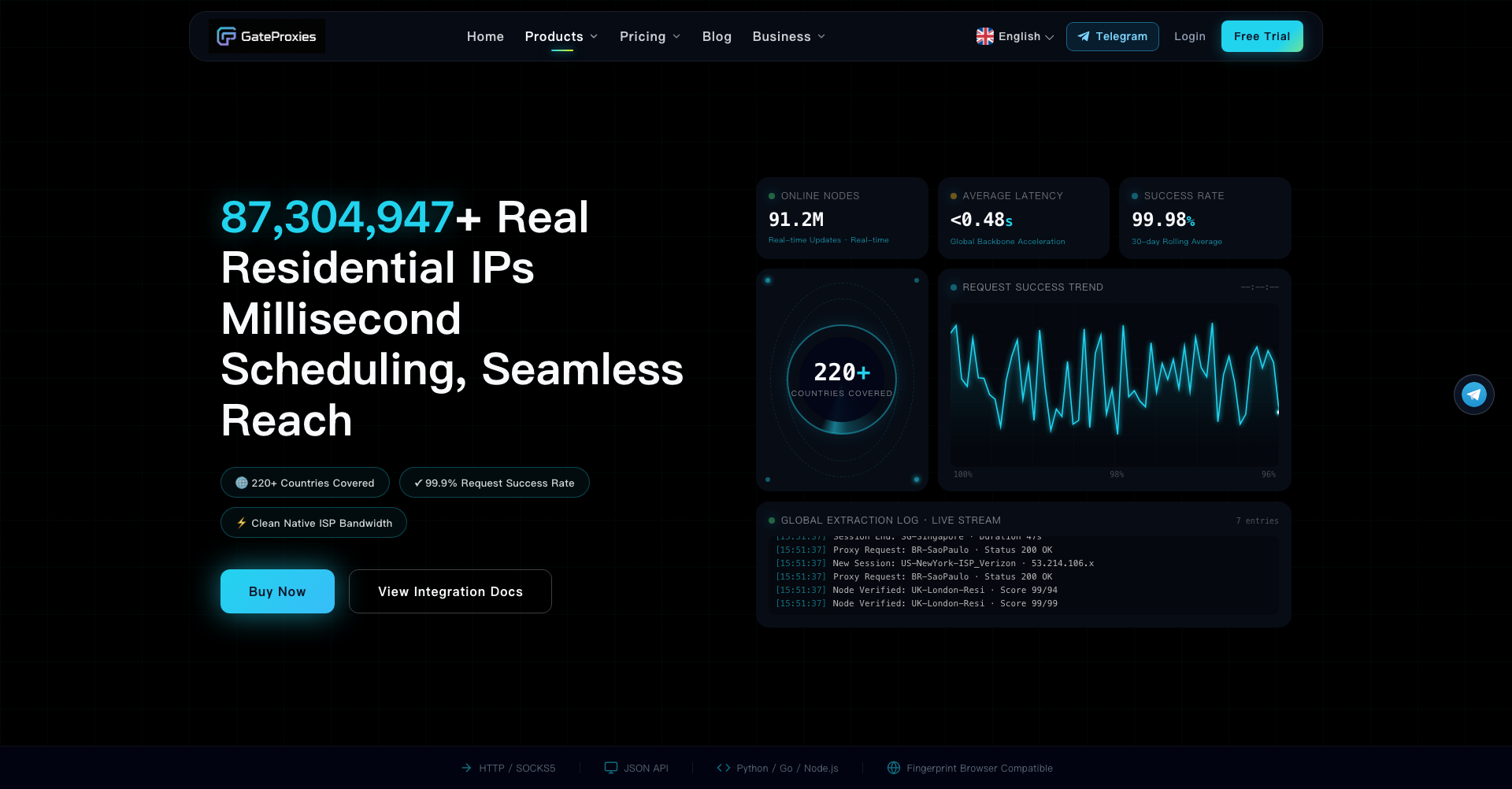
Gateproxies provides residential, mobile, ISP, IPv4, and IPv6 options for different collection patterns.
5 Match the session strategy to the collector
A session should rotate because the task is stateless, not simply because rotation is available.
Sticky sessions preserve one route through a multi-step workflow. They are appropriate when a browser agent opens a page, sets filters, changes pagination, reads details, and exports a result. Cookies and navigation state remain associated with a consistent connection.
Rotating sessions are better for independent URLs that do not depend on earlier state. A distributed product monitor may assign separate routes to separate product pages. A regional sampling job may intentionally compare results across many exits. Rotation helps distribute independent requests, but it can damage a stateful flow if the address changes mid-session.
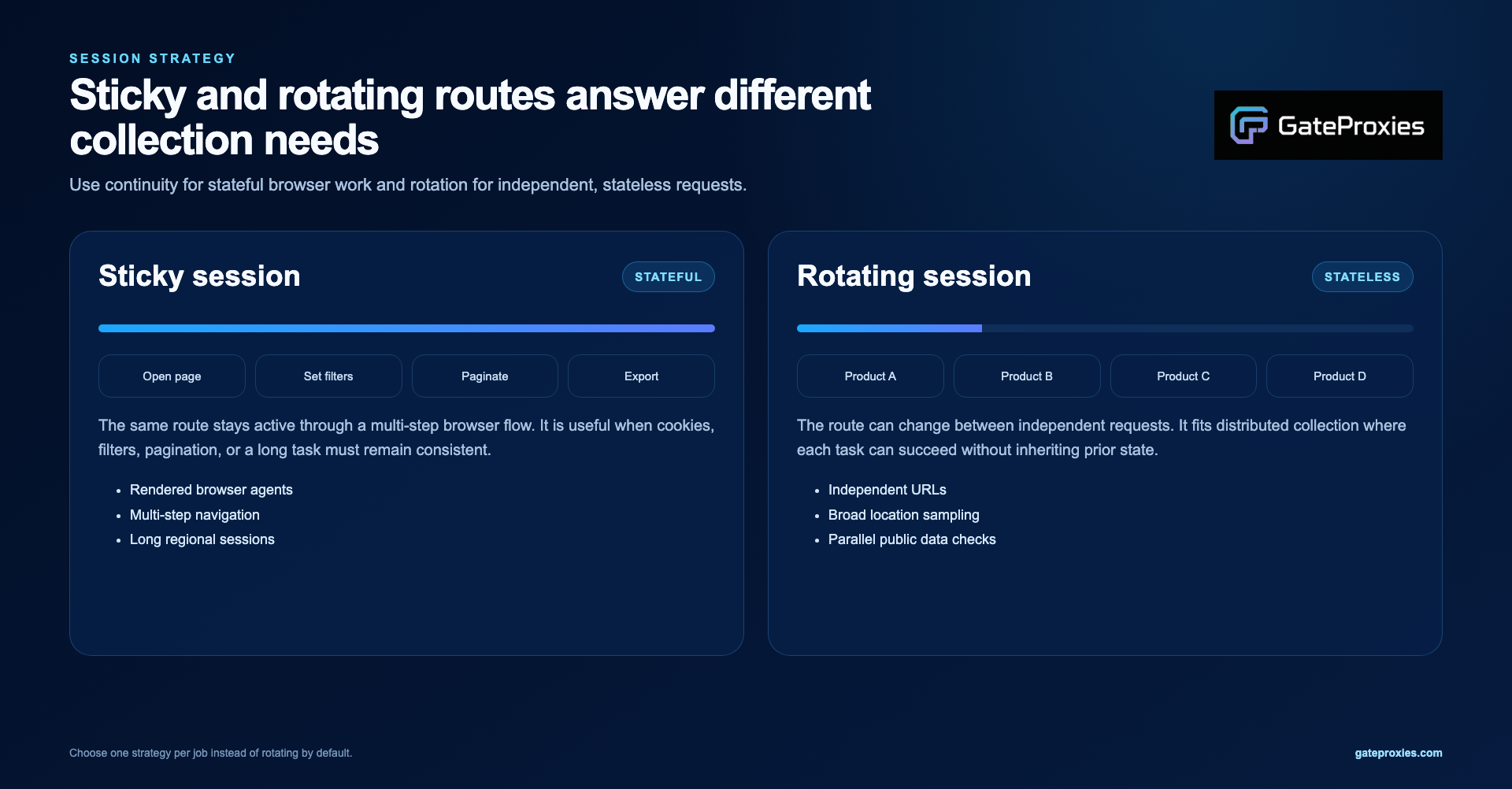
Sticky sessions support stateful browser work. Rotating sessions support independent and parallel requests.
The session key should be explicit in the collection design. Record when it starts, what requests belong to it, and when it expires. This makes retries safer because the system knows whether a failed task can use a new route or must continue the existing session.
6 Validate geographic accuracy
An IP location check is necessary, but it is not enough.
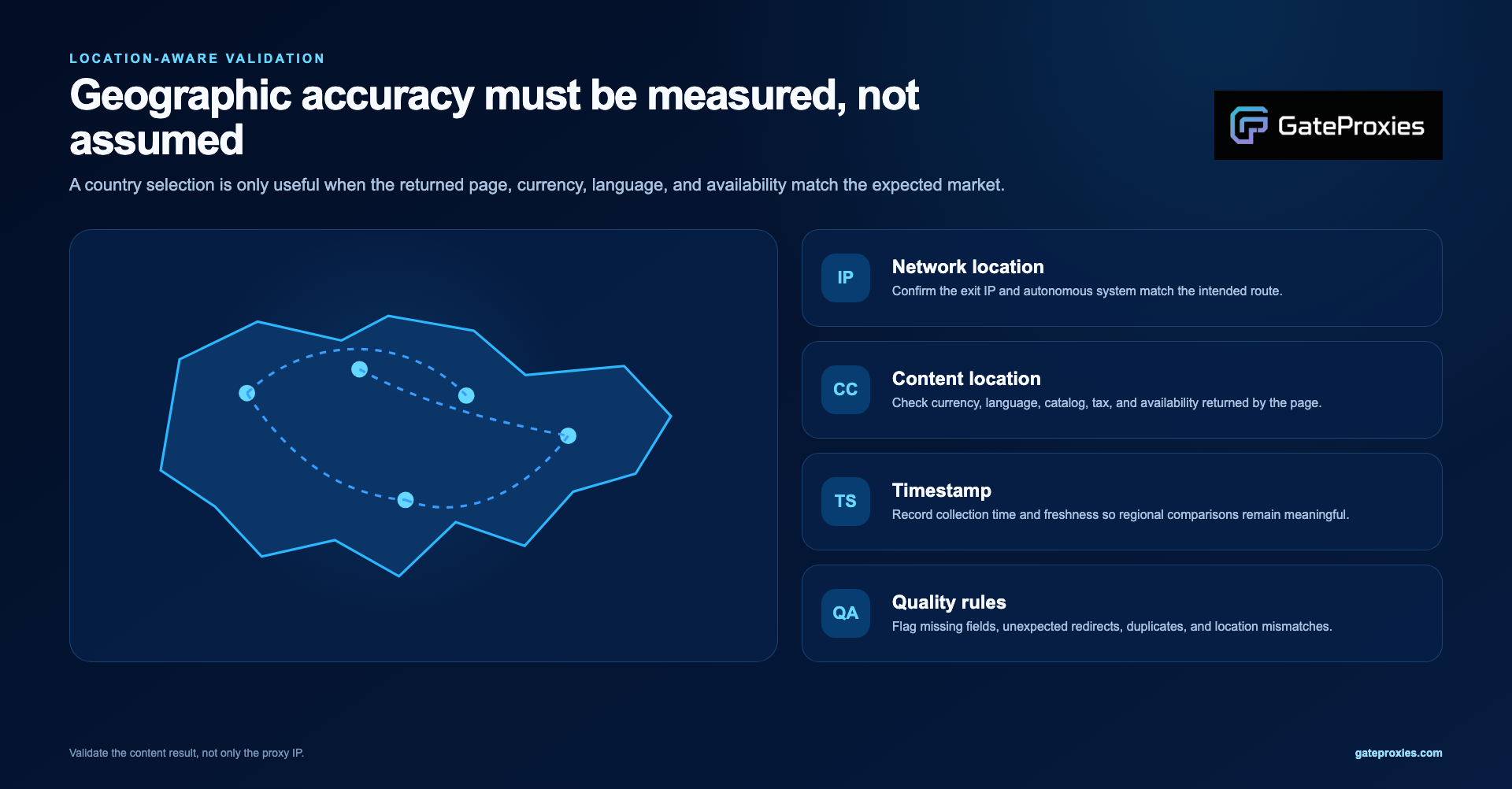
Validate the page result as well as the exit IP. Currency, language, catalog, tax, and availability may reveal a location mismatch.
A network intermediary may report the expected country while the website still returns a default catalog. The destination may use cookies, account settings, delivery addresses, language, or prior navigation in addition to the IP. For this reason, geographic validation should check both the network and the content.
For a price-monitoring record, store the exit country, displayed currency, language, product identifier, price, tax treatment, availability, collection time, and source URL. If the page does not match the expected market, mark the record invalid instead of forcing it into the comparison.
Comparisons should also use synchronized collection windows. Prices gathered from one country on Monday and another on Friday may reflect time rather than geography. The agent should preserve timestamps and refresh related markets together.
7 Measure cost per successful record
Bandwidth price alone does not show whether a collection route is economical.
A cheap route with frequent retries, location errors, or incomplete pages may cost more than a stable route with a higher unit price. Measure:
successful validated records;
traffic consumed per successful record;
requests and retries per result;
average collection time;
location mismatch rate;
parser failure rate;
cost of manual review.
Gateproxies residential pricing starts at $1.75 per GB for a 1 GB monthly package and decreases to $1.31 per GB at 100 GB. Mobile pricing starts at $3.00 per GB, ISP pricing at $4.50 per IP, IPv4 at $0.80 per month, and IPv6 at $0.50 per month. These are current entry points, not a permanent guarantee. The live pricing page and checkout catalog should be checked before purchase or publication.
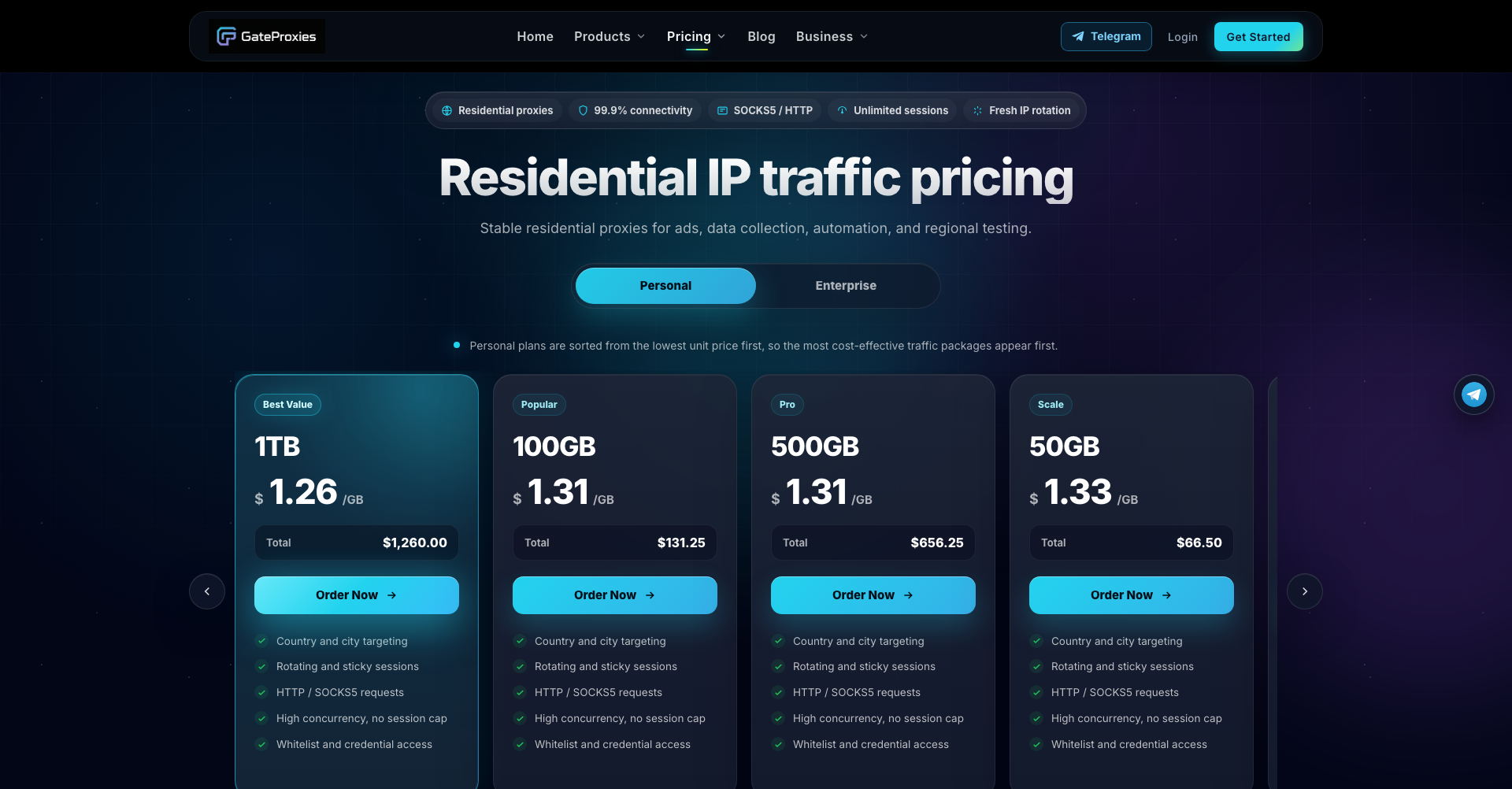
Package size, network class, location controls, and session requirements should be evaluated together.
8 Build validation into every collection run
An AI agent should never treat a returned HTTP page as proof of a successful data record.
Validation should happen before summarization. A useful ruleset checks the response status, expected page type, required fields, location markers, freshness, duplicate content, and outliers. For example, a product record without a currency should not be silently accepted as a price. A regional page that redirects to the global homepage should not count as a successful country result.
Retry only classified failures Retry timeouts and temporary server errors. Do not repeat a permanent validation failure indefinitely. | Keep the raw evidence Store the source URL, timestamp, route metadata, and a safe response reference for later review. |
Agent confidence is not data quality. A model can produce a fluent explanation of a malformed record. Deterministic validation rules should decide whether the record enters the dataset, while the agent explains or acts on records that have already passed.
When validated market or competitor data becomes an input for Telegram execution, Telegram Soft Expert can handle the next operational stage: organizing accounts, channels and chats, audience segments, broadcasts, and recurring responses. This keeps data collection, validation, network routing, and Telegram-side automation as separate layers, which makes the overall workflow easier to audit and scale.
9 Control concurrency, retries, and rate
More parallel requests do not automatically create a better dataset.
Concurrency should reflect destination capacity, project authorization, and the complexity of each page. A rendered browser consumes more memory and time than a simple HTTP request. Aggressive parallelism can produce timeouts, duplicate work, higher bandwidth use, and unnecessary load on the source.
Use bounded queues, request budgets, exponential backoff, and circuit breakers. When a destination begins returning errors, reduce pressure and investigate. Separate connection failures from parsing failures so the routing layer does not rotate endlessly when the real issue is a changed page structure.
10 Keep compliance and data provenance visible
Technical access does not create permission to collect or reuse information.
Before collection begins, review the source terms, robots instructions where applicable, privacy obligations, copyright limits, contractual restrictions, and the project's legitimate purpose. Do not collect personal or private information simply because it is technically reachable. Apply retention limits and access controls to the resulting dataset.
For every dataset, preserve provenance: source, collection time, permitted purpose, transformation history, and validation result. This matters when an AI answer must be corrected, a record must be removed, or a team needs to explain where a conclusion came from.
11 Implementation checklist
✓ Define the allowed sources and exact fields before selecting infrastructure.
✓ Use an official API when it satisfies the requirement.
✓ Choose residential, mobile, ISP, IPv4, or IPv6 according to the workload.
✓ Choose sticky or rotating behavior deliberately.
✓ Verify both the exit IP and the content location.
✓ Measure cost per validated record instead of price per gigabyte alone.
✓ Classify failures before retrying or rotating.
✓ Keep raw evidence and provenance for every accepted record.
✓ Protect network intermediary credentials and never include them in logs or screenshots.
✓ Follow source terms, privacy rules, and project authorization.
Conclusion
AI agents are making live web data collection easier to orchestrate, but they do not remove the need for sound infrastructure. Reliable results come from a complete system: a defined task, a suitable network route, deliberate session behavior, geographic verification, deterministic validation, controlled retries, and traceable storage.
Residential network nodes are useful for location-sensitive public data, mobile network nodes for carrier-specific observations, ISP network nodes for persistent sessions, and IPv4 or IPv6 according to compatibility. The best route is the one that produces accurate, validated records at a sustainable cost.
Gateproxies provides these network options in one workspace, allowing a team to match the route to the agent instead of forcing every collection job through the same type of network node.
Build the network layer around the workload
Compare residential, mobile, ISP, IPv4, and IPv6 options, then confirm live availability and package terms inside Gateproxies.

Download Telegram Expert - software for Telegram promotion
Telegram Expert is professional software for fast channel growth and sales in Telegram. Launch mass mailings and invites, warm up accounts without bans, consolidate dialogs in one place, and scale your team. All in one window - fast, safe, and tailored to your tasks.
What it can do:
- TDATA Converter - массово переводит session+json в TDATA.
- Booster - account warm-up via smart dialogs to increase trust.
- Registrar - account creation via any SMS services with the sms-activate standard.
- Duplicator - a second session for existing accounts for transfer and protection.
- Forwarder - routes incoming replies to a working group and sends replies to clients.
- Interceptor - catches messages by keywords from chats/channels and forwards them to you.
- Invite via admin - invitations even to restricted groups.
- Channel and chat cloner - full copies, including protected content.
- Reporter - mass complaints about messages/users/channels.
No one has left a comment yet

Dolphin Anty: An Antidetect Browser for Telegram Multiaccounting
Managing multiple Telegram accounts has become standard practice. Some users promote channels, others run ads, work with clients or trade crypto. A regular browser or the Telegram app is usually enough when you only have a few accounts. But as that number grows, keeping track of the right profile and constantly logging back into sessions quickly becomes a mess. This is exactly where an antidetect browser like Dolphin Anty can help. It helps organize any number of accounts by keeping each one ...

Artificial Intelligence in the Telegraph, Most Popular
AI in Telegram: The Most Popular Options Artificial intelligence is widely used in business, household activities, education, and creativity. Nowadays, bots have emerged that allow you to work without foreign SIM cards or VPNs. There are several such bots, and they are easy to use. Typically, you need to pay for them, but free trial versions are also available. Let’s take a closer look at each of them. Chat GPTTrueBot A multifunctional product with several neural network options for wri...

How to Avoid Spam Blocks and Bans in Telegram in 2026
Telegram remains one of the most popular platforms for communication, marketing, and project promotion. Many companies, traffic arbitrage specialists, channel owners, and Telegram marketing professionals use the platform to attract audiences, make sales, and manage communities. However, as Telegram’s popularity grows, the platform is also strengthening its anti-spam measures. Users who actively interact with audiences, send bulk messages, invite people to groups, or operate multiple accounts ...

From Search to Telegram: Building a Smarter Geo-Targeted Lead Generation Strategy in 2026
[media mw=100]3387[/media] Modern lead generation is no longer simply about driving as much traffic as possible to a landing page. For businesses operating across multiple countries, the bigger challenge is understanding what potential customers actually see, search for, and respond to in each market. Search results, advertising messages, pricing, recommendations, and online communities can all vary by location. As a result, marketers need to look beyond global averages and underst...