

Competitor Analysis on Telegram: How to Scrape Data Without Hitting the Limits
Telegram has long outgrown its role as "just a messenger" — for many niches, it's the primary channel for reaching an audience: channels, chats, bots, mini-apps. And wherever there's an audience, there's competition. Marketers, SMM specialists, and product teams increasingly keep an eye not only on their own channels but on their competitors' as well: how many subscribers they have, how often they post, how strong their engagement is, and which topics resonate most.
It sounds simple enough — "just go look." In practice, manually monitoring dozens of channels quickly turns into a time sink. Sooner or later the question of automation comes up: write a script that collects the needed metrics on its own. And that's where things get interesting, because Telegram isn't exactly thrilled about anyone mass-extracting data from its ecosystem, and it defends itself with rate limits.
This article covers what data is actually worth collecting when analyzing competitors, the technical methods people use, why scraping runs into restrictions, and how to structure the process so you don't end up with a banned account or a request-level block.
Why Scrape Competitors on Telegram
Before diving into the technical side, it's worth understanding which metrics are actually worth chasing. Typically, the interest lies in:
Subscriber dynamics — is the channel growing, stagnating, or losing audience.
Posting frequency and timing — how often a competitor posts, whether they take days off.
Engagement — views, reactions, comments, and shares relative to subscriber count.
Content formats — text, video, polls, stories — what performs best.
Ad placements — which channels a competitor uses to buy traffic, and how often.
Tone and topics — what they write about, which audience pain points they address.
Data collected manually goes stale fast, and without regular snapshots it's hard to spot a trend. Hence the pull toward automation — but it's important to draw a clear line between "analyzing public data" and intrusively harvesting users' personal information.
What Tools Are Used to Scrape Telegram
Telegram has several "entry points," each with its own capabilities and limitations.
Bot API
The most accessible route is creating a bot and working through the official Bot API. The upside is that it's an officially supported interface with clear documentation. The downside: a bot sees far from everything — it can't simply "walk into" someone else's channel and read message history unless it's been added there with the right permissions. For covert competitor monitoring, this option generally doesn't work.
MTProto Clients (Telethon, Pyrogram)
A much more flexible path is working through the MTProto client protocol using libraries like Telethon or Pyrogram in Python. Essentially, the script logs in as a regular user account and gets access to everything an ordinary person would see: public channels, message history, post view counts, member lists (if public), and so on.
This is the approach most commonly used for competitor analysis, since it provides access to the same data a real person browsing the channel would see. But it also comes with the most significant restrictions, because Telegram actively watches for behavior that looks automated.
Web Version and HTML Scraping
For fully public channels, you can skip authorization entirely — open channels are accessible via the web preview (t.me/channelname). This removes some of the risk tied to account bans, but it also cuts down the available data: without authorization, you can't get full message history, precise reaction counts, and more.
Why Scraping Runs Into Limits
Like any major platform, Telegram fights automated, large-scale data collection — this protects its servers from overload and reduces the risk of abuse (spam, fake engagement, personal-data scraping). The restrictions operate on several levels at once:
Flood wait at the account level. If an MTProto client sends requests too frequently, Telegram will eventually return a FLOOD_WAIT error specifying how many seconds to wait. Ignoring that pause and retrying immediately sharply increases the wait time on subsequent requests.
Limits on actions per unit of time. There are unofficial thresholds on the number of API requests, chats opened, profile lookups, and so on within a given minute or hour. Exceeding them leads straight to temporary restrictions.
Behavioral analysis and IP reputation. Telegram watches not just request frequency but behavioral patterns: hitting hundreds of channels in a row with no pauses, requests from the same IP across many accounts, activity patterns atypical for a human (e.g., round-the-clock activity with no breaks). All of this raises the odds that an account gets flagged as suspicious, then restricted or banned outright.
Method-specific limits. Certain API methods (like pulling the full member list of a large channel) carry their own, stricter limits, independent of the account's overall activity level.
The more aggressively and repetitively a script hammers the API, the faster it runs into restrictions — and sometimes permanently, if Telegram decides the account is being used in bad faith.
How to Build a Scraper That Doesn't Hit the Limits
There's no single silver bullet here — it's a combination of practices.
1. Slow down and add randomness
The most common mistake is hitting the API at the fastest pace the code allows. It's much smarter to build in pauses between requests — not fixed ones, but with a bit of random variance (say, 2–6 seconds instead of exactly 3). This makes the script's behavior look less like an assembly line and lowers the chance of triggering flood control.
2. Collect data in batches, on a schedule
You don't need to monitor competitors in real time. For most purposes, pulling metrics once a day or a few times a week is plenty. This kind of cadence naturally reduces load on the account and makes the behavior more "human" — real people don't scroll their feed 24/7 either.
3. Spread the load across multiple accounts
If you need to monitor dozens or hundreds of channels, it makes sense to distribute them across several working accounts rather than funneling everything through one. This lowers the request frequency per account and reduces the risk that a single triggered limit halts the entire collection process.
If this kind of monitoring runs on an ongoing basis, some repetitive work can be moved into Telegram Expert. The software can be used to work with multiple Telegram accounts, search and monitor chats and channels, and automate recurring operations. This becomes especially useful at scale, when manually switching between accounts and separate workflows starts taking more time than the analysis itself.
4. Cache what doesn't change every hour
Channel name, description, creation date — this kind of data doesn't need to be re-fetched on every collection cycle. Caching static information and only refreshing dynamic metrics (subscriber counts, recent post views) can significantly cut the number of API calls.
5. Distribute requests across IP addresses
A separate sore point: if several accounts or scripts operate from the same IP address, that's an extra signal to the platform that it's not dealing with independent users but a single automated system. This becomes especially noticeable at scale — the more channels and accounts under monitoring, the more important it is not to concentrate all activity on one network address.
This is where network gateways typically come in alongside MTProto clients — they let you spread accounts and request streams across different IPs, reduce the correlation between them from the platform's point of view, and simultaneously solve a related problem: viewing content from a specific region, if you need to see it the way users in that country would. Mobile or residential IP relays work well for this kind of scenario — they look less like datacenter addresses and are less likely to get flagged as a source of mass automation. Services like ProxyLine offer gateway pools of this kind, which are easy to integrate into Telethon or Pyrogram scripts by setting a gateway at the client connection level for each account individually.
When working with a large pool of accounts, it is usually more convenient to connect the network infrastructure to an automation tool rather than configure every process manually. Telegram Soft Expert can be used in this setup for centralized work with Telegram accounts and proxies, distributing workflows across separate profiles. This makes scaling easier as the number of accounts, channels, and parallel tasks grows.
6. Treat rate-limit errors as part of the logic, not an exception
A well-built scraper doesn't just "crash" on a FLOOD_WAIT — it builds that scenario into its core workflow: automatically waiting out the required time, logging the event, and resuming from where it left off. This removes the need to manually restart data collection over and over, and reduces the risk of a harsher restriction on a repeat error.
7. Don't chase excessive detail
Often the real reason for hitting limits is trying to grab every possible metric "just in case" — full member lists, message edit history, per-user reaction breakdowns. If a competitor analysis really only needs 5–7 key indicators, there's no reason to load the script down with requests for data that will never make it into the final report.
Pre-Launch Checklist for a Competitor Scraper
A quick summary of what to check before running data collection on an ongoing basis:
Is the actual goal defined — which 5–10 metrics are genuinely needed, rather than "collect everything"?
Are pauses between requests built in, with randomized variance?
Is a collection schedule set up instead of continuous polling?
Is the load distributed across multiple accounts if there are many channels?
Are different IP addresses used for different accounts to reduce the risk of network-based blocks?
Is flood-control error handling built directly into the script's logic?
Is the scraper avoiding personal user data in favor of aggregated channel metrics?
Competitor analysis on Telegram isn't a one-off data pull — it's an ongoing process that only survives long-term when it's built carefully. The platform's limits aren't an obstacle to "hack around," but a constraint to work with: a sensible request pace, distributed load, IP diversification, and a reasonable scope of metrics together produce a stable monitoring system that doesn't fall apart after the first week. For anyone planning to scale data collection to dozens of accounts and hundreds of channels, it's worth thinking through the infrastructure in advance — including a pool of gateway addresses — so you don't run into mass blocks at the exact moment competitor data matters most.

Download Telegram Expert - software for Telegram promotion
Telegram Expert is professional software for fast channel growth and sales in Telegram. Launch mass mailings and invites, warm up accounts without bans, consolidate dialogs in one place, and scale your team. All in one window - fast, safe, and tailored to your tasks.
What it can do:
- TDATA Converter - массово переводит session+json в TDATA.
- Booster - account warm-up via smart dialogs to increase trust.
- Registrar - account creation via any SMS services with the sms-activate standard.
- Duplicator - a second session for existing accounts for transfer and protection.
- Forwarder - routes incoming replies to a working group and sends replies to clients.
- Interceptor - catches messages by keywords from chats/channels and forwards them to you.
- Invite via admin - invitations even to restricted groups.
- Channel and chat cloner - full copies, including protected content.
- Reporter - mass complaints about messages/users/channels.
No one has left a comment yet

Telegram Banned? 2026 Guide to Fix Account Bans, Region Blocks & IP Issues
body, article, section, div, p, h1, h2, h3, li, .content-section { text-align: justify; } body { margin: 20px; font-family: Arial, Helvetica, sans-serif; line-height: 1.6; } In the evolving landscape of global social media marketing, Telegram has shifted from a "wild west" of anonymity to a sophisticated ecosystem with some of the most stringent anti-spam measures in the industry. For many digital marketers, the journey ends...

Complete Guide to Telegram: Channels, Groups, Bots, and Mini Apps
Telegram has long outgrown the format of «just a messenger.» It’s a place where a brand speaks in its own voice, the audience responds directly, and the entire user journey fits into a few clicks: post => chat => action. Below is a practical, lively breakdown of how to build a channel, group, bot, and mini app so that your audience stays engaged and you stay in control of growth. Channel: a voice that can be heard from any feed A channel is a promise made to your reader in the first ten seco...

From Search to Telegram: Building a Smarter Geo-Targeted Lead Generation Strategy in 2026
[media mw=100]3387[/media] Modern lead generation is no longer simply about driving as much traffic as possible to a landing page. For businesses operating across multiple countries, the bigger challenge is understanding what potential customers actually see, search for, and respond to in each market. Search results, advertising messages, pricing, recommendations, and online communities can all vary by location. As a result, marketers need to look beyond global averages and underst...
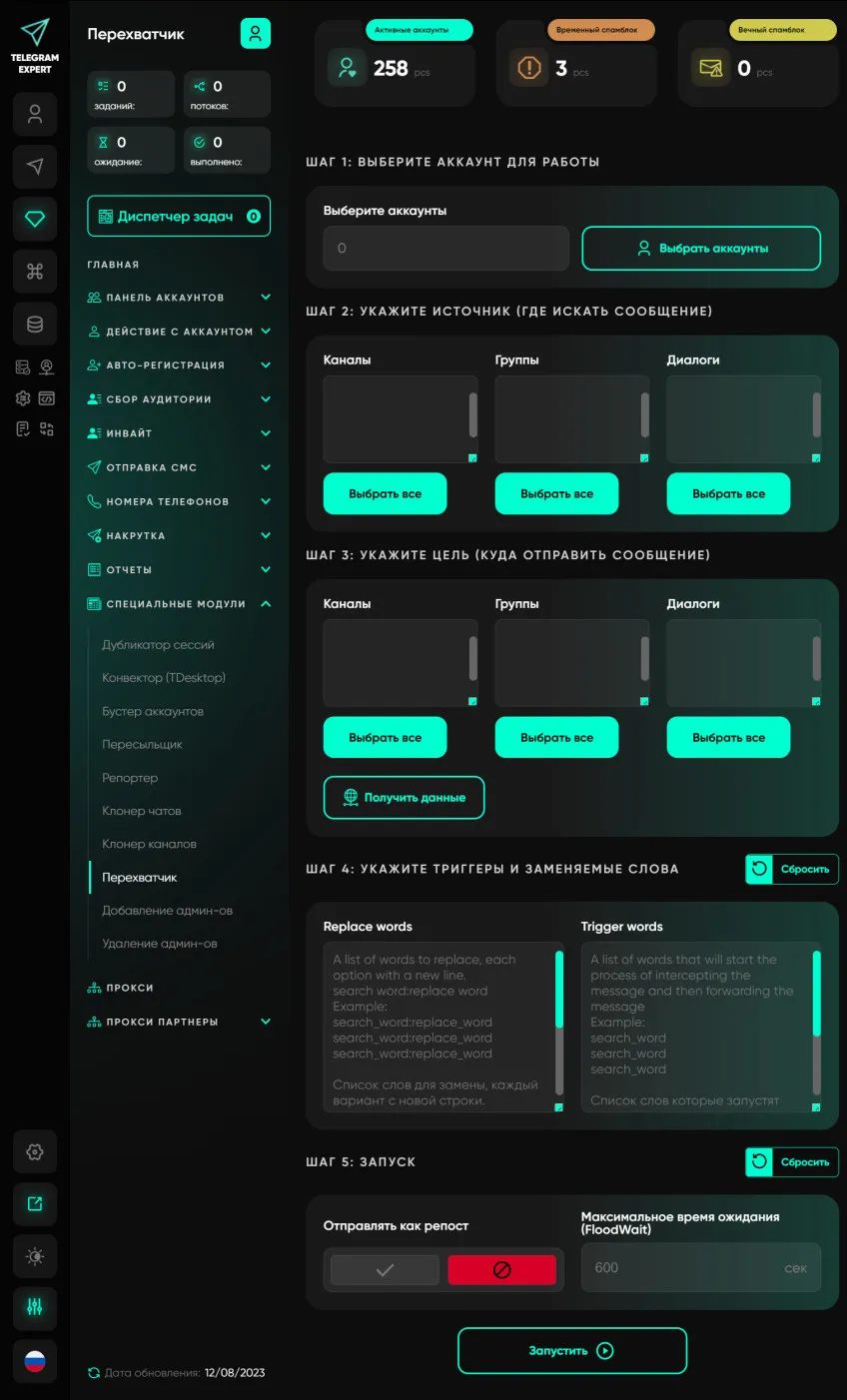
Interceptor
Our software module allows users to monitor groups, channels, conversations and forward all messages containing certain keywords. This module has many applications; you can use it to search for potential clients or to automate the filling of telegrams of groups and channels in real time. This module will become your personal Telegram marketer and will bring a large number of clients. To work with this module, it is recommended to use high-quality elite proxy servers.