
The Role of Spy Services in Affiliate Marketing: Why You Need Them and How to Use Them
In the world of media buying, there is a common saying: "You either pay for your own mistakes during testing, or you invest in a Spy service subscription and learn from others." In 2026, as ad network algorithms have become more opaque and the battle for user attention more expensive, Spy tools have shifted from "optional add-ons" to a mandatory part of a media buyer's tech stack. In this article, we will break down the mechanics of these "spy" tools, their real value, and effective strategies for using them to ensure you aren't just copying, but creating.
The Anatomy of a Spy Service: A Look Behind the Scenes
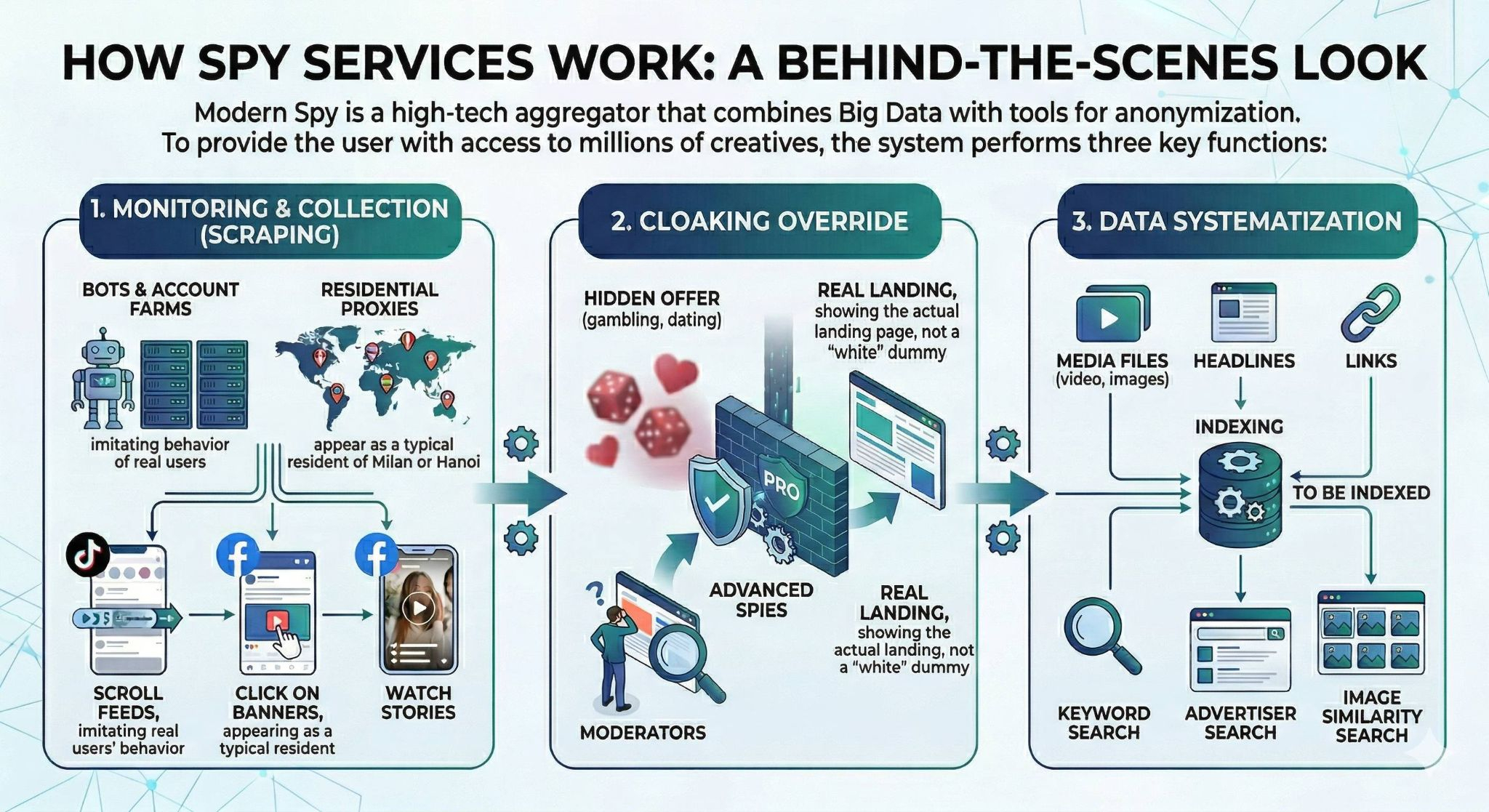
A modern Spy service is a high-tech aggregator that combines Big Data with advanced anonymization tools. To provide users with access to millions of creatives, the system performs three key functions:
Monitoring and Scraping: Services utilize massive account farms and residential proxies. Specialized bots simulate the behavior of real users across different countries: they scroll through TikTok and Facebook feeds, click on banners, and watch stories. To the platform's algorithms, these bots look like typical residents of Milan or Hanoi, allowing the service to "catch" relevant ads.
Bypassing Cloaking: Many affiliates hide their real offers (Gambling, Dating, etc.) from moderators using cloaking. Advanced Spy services can bypass these barriers, showing you the actual landing page the customer sees rather than the "white" safe page.
Data Systematization: All discovered media files, headlines, and links are indexed. This allows for searching by keywords, specific advertisers, or even visual similarity between images.
Five Scenarios for Using a Spy Service
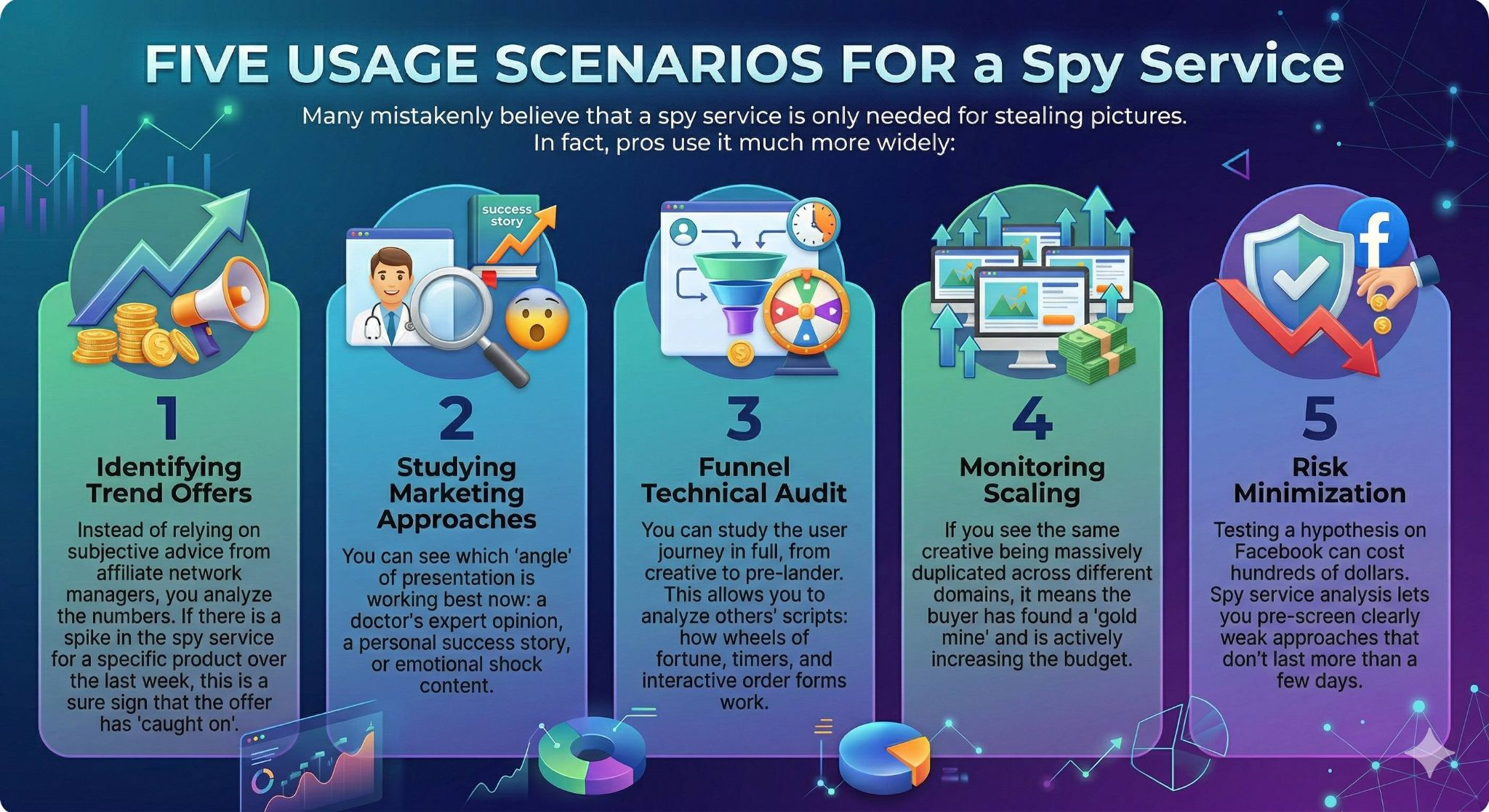
Many mistakenly believe that a Spy tool is only for "stealing" images. In reality, professionals use it much more broadly:
Identifying Trending Offers: Instead of relying on subjective advice from affiliate managers, you analyze the data. If you see a surge in ads for a specific product over the last week, it’s a clear sign the offer is "converting."
Analyzing Marketing Angles: You can see which "angle" or hook is currently performing best: an expert medical opinion, a personal success story, or high-impact shock content.
Technical Funnel Audit: You can study the entire user journey—from the creative to the pre-lander. This allows you to analyze competitors' scripts, such as how they use interactive wheels, timers, and lead forms.
Monitoring Scaling: If you see the same creative being mass-duplicated across dozens of different domains, it means the buyer has found a "gold mine" and is aggressively increasing their budget.
Risk Minimization: Testing a hypothesis on Facebook can cost hundreds of dollars. Spy service analysis allows you to filter out weak approaches that don't last more than a day or two.
Tool Specialization by Traffic Source
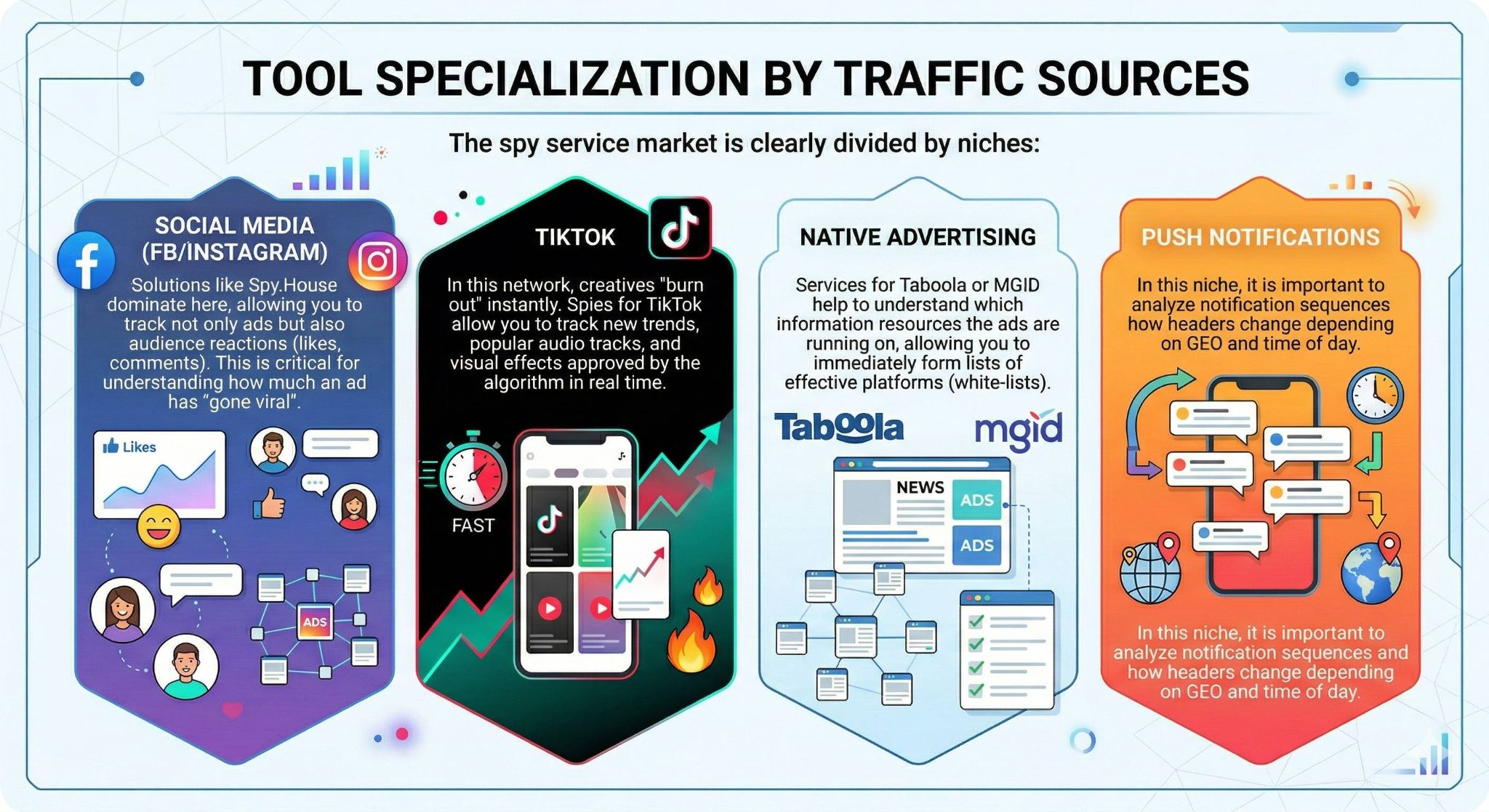
The Spy service market is clearly segmented by niche:
Social Media (FB/Instagram): Solutions like Spy.House dominate here, allowing you to track not just the ads, but also audience reactions (likes, shares). This is critical for understanding "virality."
TikTok: Creatives burn out instantly on this platform. TikTok Spy tools allow you to monitor new trends, popular audio tracks, and visual effects approved by the algorithm in real-time.
Native Advertising: Tools for Taboola or MGID help you identify exactly which news portals the ads are running on, allowing you to build effective "white lists" immediately.
Push Notifications: In this niche, it is vital to analyze notification chains and how headlines change depending on the time of day and the user's GEO.
The Art of Filtering: How to Find a Winning Bundle
To avoid drowning in "junk" ads—those launched by mistake or instantly banned—use a smart filtering strategy:
Ad Lifetime: This is the key metric. Filter for ads that have been running for at least 5–7 days. If an ad has been active for a long time, it is profitable.
Impression Volume: Look for creatives with the highest reach to identify the major market players.
Excluding Brands: Filter out mentions of major corporations (Amazon, Nike) to focus purely on affiliate marketing approaches.
Domain Search: Once you find a successful landing page, search the service for other ads pointing to the same domain—this often reveals a competitor's entire network.
Copying vs. Uniqalization
The eternal debate among affiliates comes down to two paths:
Direct Copying (Ctrl+C, Ctrl+V): It’s fast, but dangerous. Facebook and Google algorithms instantly recognize "digital fingerprints." Using someone else's creative often leads to an instant ban or low reach due to content redundancy.
Deep Uniqalization (Recommended): You take the winning idea as a foundation but rework it: change the color palette, edit new footage, replace the voiceover, and clean the file metadata. This signals "freshness" to the system while keeping the proven psychological triggers.
The Economics: Is It Worth It?
The cost of high-quality software ranges from $100 to $500 per month. For a beginner, this is a significant expense, but the numbers speak for themselves: one failed test often costs more than a monthly subscription. There are ways to optimize costs:
Joint access (Group Buys), though these carry the risk of account bans.
Affordable alternatives like Spy.House, which offers plans starting from $29 and a 7-day free trial, perfect for getting started.
The Future of Spy Technologies in 2026
The market continues to evolve:
AI Integration: Services are starting to suggest which creative elements (button color, font type) correlate with a higher CTR.
Feedback Analytics: Automated parsing of comments allows you to understand the pain points of a competitor's audience.
In-App Analysis: Deep tracking of what happens inside mobile apps after the installation.
Summary
In 2026, a Spy service is your "X-ray" for the advertising market. It shouldn't replace your creativity but should serve as the foundation for your decision-making. Remember: in affiliate marketing, the winner isn't the one who stole it first, but the one who took a working concept and made it 20% better.
Important: this website is the only official website of the Telegram Expert project. Licenses, updates, and official technical support are available only through this website. Any other websites offering Telegram Expert are not affiliated with BLB.Team and are either unofficial or fraudulent.
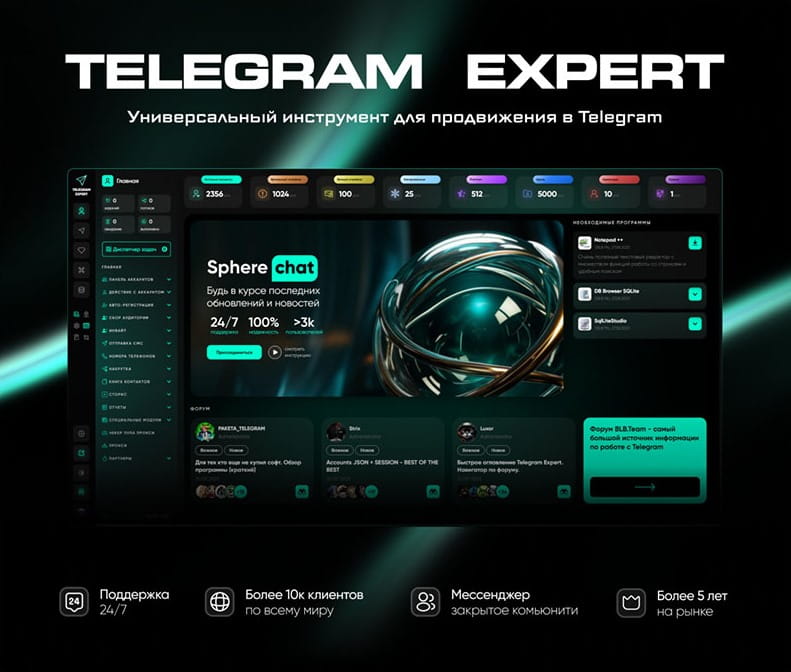
Download Telegram Expert - software for Telegram promotion
Telegram Expert is professional software for fast channel growth and sales in Telegram. Launch mass mailings and invites, warm up accounts without bans, consolidate dialogs in one place, and scale your team. All in one window - fast, safe, and tailored to your tasks.
What it can do:
- TDATA Converter - массово переводит session+json в TDATA.
- Booster - account warm-up via smart dialogs to increase trust.
- Registrar - account creation via any SMS services with the sms-activate standard.
- Duplicator - a second session for existing accounts for transfer and protection.
- Forwarder - routes incoming replies to a working group and sends replies to clients.
- Interceptor - catches messages by keywords from chats/channels and forwards them to you.
- Invite via admin - invitations even to restricted groups.
- Channel and chat cloner - full copies, including protected content.
- Reporter - mass complaints about messages/users/channels.
No one has left a comment yet
Telegram Bots: automation that saves time and keeps respect
A bot in Telegram is needed wherever the same steps repeat: onboarding, navigation, file delivery, short requests, reminders, and opt-in broadcasts. A good bot speaks clearly, avoids unnecessary questions, and always leaves a path to a human. Where a bot brings maximum value Onboarding: introduce yourself, clarify the goal, offer 2–3 short paths. Content navigation: categories, quick search, “best of the month”. Requests/appointments: minimal fields, confirmation, reminde...
How to Manage Multiple Telegram Accounts Safely (Without Mixing Sessions)
Telegram Has Become a Business Tool Telegram is no longer just a messaging app. Today it's used by affiliate marketers, crypto communities, e-commerce businesses, customer support teams, and digital agencies to communicate with customers and manage online communities. As businesses grow, so does the number of Telegram accounts they need. One account may be dedicated to customer support, another to affiliate partnerships, while others are used for regional communities or different brands. ...
How to Choose and Set Up IP Connections for Data Collection and Global Workflows
A practical guide to selecting gateway types, configuring connections, and testing them before scaling a project. Introduction Collecting online data across markets can be more complicated than sending requests to a website. Search results, product prices, available content, and advertising displays may vary by region. At the same time, automated workflows need a connection setup that is appropriate for their workload, location requirements, and budget. A gateway...

Channel Cloner
Do you want to fill your marketing Telegram channel with a minimum of effort? Then you need a Channel Cloner.Advertise on telegram! The module is very effective for filling channels with interesting information; in a matter of minutes you can fill a channel by cloning. It is used masse if you need to increase your network of channels and attract an audience. Examples of the work of this module can be seen everywhere in Telegram. You have probably seen channels where posts are published with a ce...