

Telegram Multi-Accounting in 2026: How to Scale Dozens of Accounts Without Getting Blocked
Telegram multi-accounting in 2026 is no longer just about running several profiles — it’s a full-scale infrastructure challenge. Telegram continues strengthening its anti-fraud systems, analyzing IP addresses, behavioral patterns, device fingerprints, and action frequency.
If a few years ago basic gateways and simple tools were enough, today scaling Telegram accounts requires a properly built architecture: anti-detect environments, mobile IP relays, traffic distribution, and structured warm-up strategies.
Let’s break down how to avoid Telegram bans and build a sustainable multi-account system.
Why Telegram Strengthened Anti-Fraud in 2026
Telegram actively combats spam, mass messaging, and automated account farms. Anti-fraud algorithms analyze:
IP address type (mobile, residential, datacenter)
Repeated device fingerprints
Registration speed
Invite and messaging limits
Behavioral similarities between accounts
Datacenter IPs are especially risky. Telegram easily identifies hosting-based traffic, which significantly lowers account trust.
The real question in 2026 is not “How to create 50 accounts?” but “How to make 50 accounts look like 50 real users?”
Main Reasons for Telegram Account Blocks
Using Datacenter IP Gateways Datacenter IPs are easily detectable and carry low trust scores.
Shared Egress Infrastructure Shared IP pools increase the probability of anti-fraud triggers.
No Mobile IP Relay Network Mobile 4G/5G relays have significantly higher trust because they belong to real telecom operators.
Aggressive Launch Strategy Mass invites, bulk messaging, or automation without warm-up often lead to restrictions.
Identical Fingerprints Same OS, browser settings, resolution, or environment across accounts makes the network detectable.
Telegram Infrastructure in 2026: Minimum Technical Stack
To safely scale Telegram accounts, you need:
Anti-detect browser or isolated environment
Separate profile per account
Mobile egress nodes for Telegram
Geo distribution
Gradual warm-up
Limit control
Gateway quality is the core factor.
Best Gateway Types for Telegram in 2026
Connection Type | Trust Level | Block Risk | Suitable for Multi-Accounting |
|---|---|---|---|
Datacenter | Low | High | ❌ |
Shared IP | Medium | Medium | ⚠️ |
Residential | Medium | Medium | ⚠️ |
Mobile 4G/5G | High | Low | ✅ |
Mobile IPs from telecom operators look like genuine user traffic.
When working with dozens of Telegram accounts, using dedicated mobile devices without IP sharing is critical. Infrastructure like Coronium.io provides 4G/5G egress nodes on physical devices with real SIM cards, increasing trust and stability for large-scale Telegram operations.
Telegram Limits in 2026: What You Should Know
Telegram does not officially publish exact limits, but users experience practical restrictions such as:
Limited contact additions per day
Invite caps depending on account age
Restrictions on mass messaging to non-contacts
High risk when registering multiple accounts from one IP
Key recommendations:
Avoid unnatural action speed
Distribute workload
Increase activity gradually
Respect account age
The newer the account, the stricter the limits.
Account Warm-Up Strategy
Even strong infrastructure won’t help without proper warm-up.
Recommended approach:
Days 1–3:
Incoming chats
Channel subscriptions
Minimal outgoing actions
Days 4–7:
Light messaging
Group participation
Gradual activity increase
After 7–10 days, automation can be introduced progressively.
Scaling Strategy: Managing 20–50 Accounts
For safe scaling:
Use different mobile IP relays
Separate actions by time
Assign accounts specific roles
Avoid simultaneous mass actions
Match geo to target audience
Telegram scaling is an engineering process, not random execution.
Common Mistakes
Saving money on egress infrastructure quality
Buying unknown IP pools
No IP rotation
Running dozens of accounts on one server
Ignoring Telegram limits
Telegram’s anti-fraud is much smarter in 2026. Basic schemes no longer work.
Why Mobile Egress Nodes Remain the Most Stable Solution
Telegram is primarily a mobile-first platform. Most users connect from smartphones. Therefore, mobile IPs naturally match expected behavior patterns.
Using mobile infrastructure such as Coronium.io — where each device is dedicated and not shared — significantly reduces ban risks when operating Telegram multi-account networks.
It doesn’t guarantee zero bans, but it dramatically improves stability.
Conclusion
Telegram multi-accounting in 2026 requires:
Structured infrastructure
High-trust mobile egress nodes
Anti-detect environment
Proper warm-up
Limit awareness
When treated as a technical project rather than a shortcut, scaling dozens of Telegram accounts becomes predictable and sustainable.
*The material is provided for informational purposes only. The use of technologies and the knowledge obtained should be carried out in accordance with the laws of the user's country.
Important: this website is the only official website of the Telegram Expert project. Licenses, updates, and official technical support are available only through this website. Any other websites offering Telegram Expert are not affiliated with BLB.Team and are either unofficial or fraudulent.
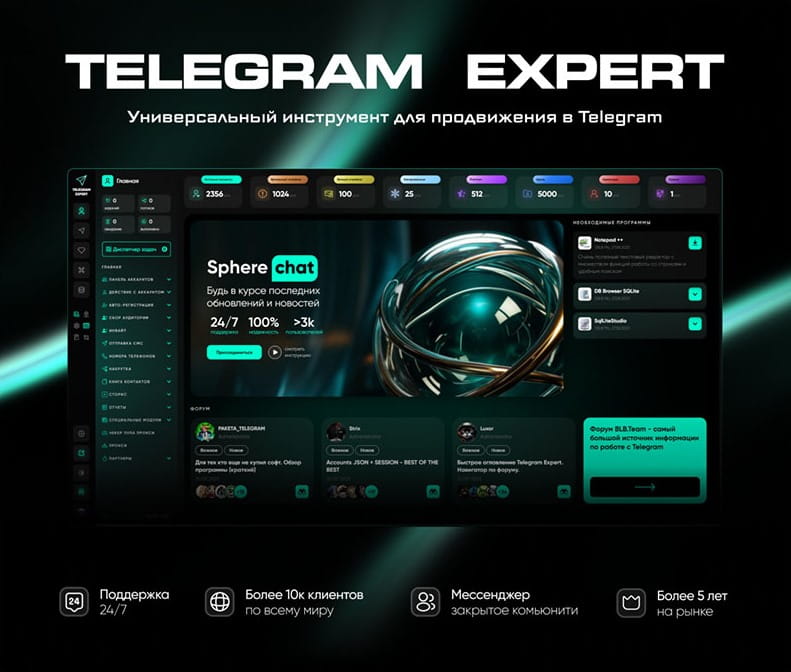
Download Telegram Expert - software for Telegram promotion
Telegram Expert is professional software for fast channel growth and sales in Telegram. Launch mass mailings and invites, warm up accounts without bans, consolidate dialogs in one place, and scale your team. All in one window - fast, safe, and tailored to your tasks.
What it can do:
- TDATA Converter - массово переводит session+json в TDATA.
- Booster - account warm-up via smart dialogs to increase trust.
- Registrar - account creation via any SMS services with the sms-activate standard.
- Duplicator - a second session for existing accounts for transfer and protection.
- Forwarder - routes incoming replies to a working group and sends replies to clients.
- Interceptor - catches messages by keywords from chats/channels and forwards them to you.
- Invite via admin - invitations even to restricted groups.
- Channel and chat cloner - full copies, including protected content.
- Reporter - mass complaints about messages/users/channels.
No one has left a comment yet
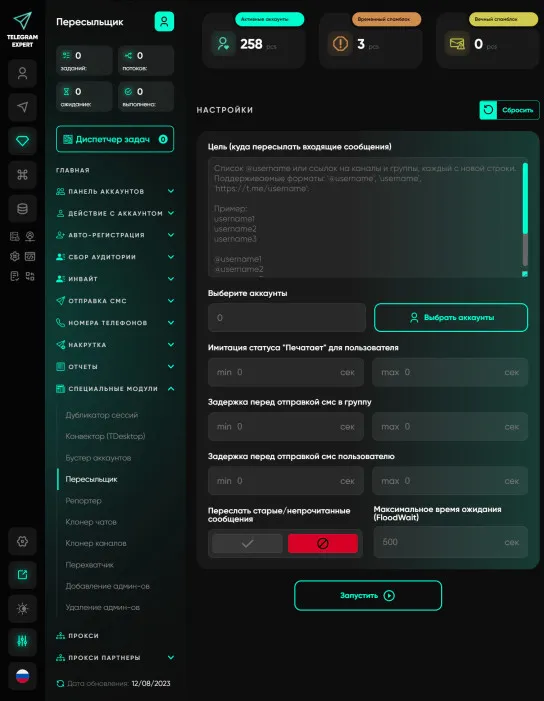
Forwarder
A unique module that works on the principle of message proxying. The principle is extremely simple, after you have sent messages from your accounts, you launch the forwarder and specify the group in which your sales managers are located. Proxy server accounts forward messages to the group, and when they see that someone from the group has responded to the message, the proxy server account forwards the response to your potential client. This allows you to communicate with a large number of people...

How to Choose and Set Up IP Connections for Data Collection and Global Workflows
A practical guide to selecting gateway types, configuring connections, and testing them before scaling a project. Introduction Collecting online data across markets can be more complicated than sending requests to a website. Search results, product prices, available content, and advertising displays may vary by region. At the same time, automated workflows need a connection setup that is appropriate for their workload, location requirements, and budget. A gateway...
How to Scale Telegram in 2026 Without Bans: Multi-Accounting, Automation and the Right Gateways
Telegram in 2026 is no longer a simple messenger – it is a competitive space with one of the strictest anti-spam systems around. If you work in traffic arbitrage, affiliate marketing or audience acquisition through Telegram, you have probably noticed the old playbook has stopped working. Mailing software burns accounts after a few dozen messages, registration numbers get flagged, and parsing returns databases full of bots. Scaling Telegram traffic without bans now depends on two things working t...
How does IP infrastructure increase business efficiency in Telegram
Every day, billions of people around the world use Telegram. Some rely on it to stay connected with friends and colleagues. Others publish content to build influence and attract followers. Many join Telegram communities to exchange ideas, discuss challenges, and seek answers. Increasingly, younger users are spending significant amounts of time on the platform. With nearly 450 million daily active users and steady growth, Telegram has become a digital ecosystem that businesses simply cannot ignor...